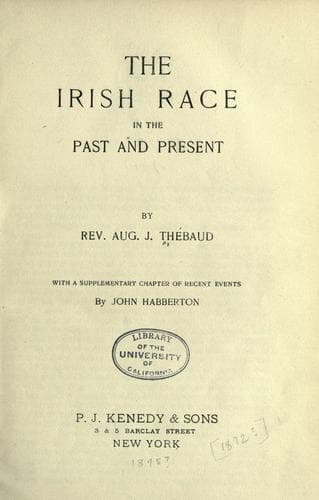
The Irish Race in the Past and the PresentThébaud, Augustus J.
History
The Irish Race in the Past and the Present
Thébaud, Augustus J.
Ireland -- History
Yet, even after becoming Christian, they preserved for a Iong
time--we speak not now of the present day--deep features of
their former character, among others the old spirit of rapacity,
and that systematic boldness which, when occasion demands, is
ever ready to intrench upon the rights of others. They soon
displayed, also, a general tendency to subject spiritual matters
to individual reason, and the great among them to interfere and
meddle with religious affairs. The Dukes of Normandy, the Kings
of England, and the Saxon Emperors of Germany, seldom ceased
disputing the rights of spiritual authority; and the learned
among them were forward to question the supremacy of Rome in
many things, and to argue against what other people, more
religiously inclined, would have admitted without controversy.
That spirit of speculation, to which the Irish Four Masters
partly ascribed the introduction of Protestantism into England,
was rampant in the schools of these northern nations, when a
superior civilization gave rise to the erection of universities
and colleges in their midst.
But over and above that systematic philosophical spirit, their
character was deeply imbued with a material rapacity which,
after all, has always constituted the great vice of those
northern tribes. It is unnecessary to remind the reader that, in
England chiefly, Protestantism was particularly grateful to the
avaricious longings of the courtiers of Henry VIII. and
Elizabeth. The confiscation of ecclesiastical property and its
distribution among the great of the nation was the chief
incentive which moved them to adopt the convenient doctrines of
the new order, and subvert the old religion of the country. This
rapacious spirit showed itself also in Germany, though not so
conspicuously as in England; and certainly, in both countries,
the universal confiscation of the estates of religious houses,
and the robbery of the plate and jewels of the churches, are
prominent features in the history of the great Reformation.
William Cobbett has written eloquently on this subject, and
marshalled an immense array of facts so difficult of denial that
the defenders of Protestantism were compelled to resort to the
petty subterfuge of retorting that the great English radical was
a mere partisan, who never spoke sincerely, but always supported
the theory he happened to take up by exaggerated and distorted
facts, which no one was bound to admit on his responsibility.
Such was their reply; but the awkward facts remained and remain
still unchallenged.
But, since Cobbett, men who could not be accused of partisanship
and exaggeration have published authentic accounts of the
unbounded rapacity of the Reformers of the sixteenth century, in
England particularly, which all impartial men are bound to
respect, and not attribute to any unworthy motive, since they
are supported even by Protestant authorities. We quote a few,
taken from the "History of the Penal Laws" by Dr. R. R. Madden:
Public-domain text, read in full here on John Shaqi.
Reviews
Reviews
No reviews yet
Be the first to share your thoughts on this work.
Elsewhere in the archive
Join the Discussion
Join the discussion
Sign in to leave a comment or review.
Sign InorCreate an account