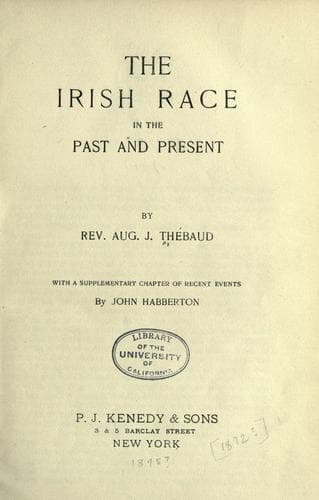
The Irish Race in the Past and the PresentThébaud, Augustus J.
History
The Irish Race in the Past and the Present
Thébaud, Augustus J.
Ireland -- History
"The Earl of Warwick, afterward Duke of Northumberland, was the
first of the aristocracy in England who inveighed publicly
against the superfluity of episcopal habits, the expense of
vestments and surplices, and ended in denouncing altars and the
'mummery' of crucifixes, pictures and images in churches.
"The earl had an eye to the Church plate, and the precious
jewels that ornamented the tabernacles and ciboriums. Many
courtiers soon were moved by a similar zeal for religion--a lust
for the gold, silver, and jewels of the churches. In a short
time, not only the property of churches, but the possession of
rich bishopries and sees, were shared among the favorites of
Cranmer and the protector (Somerset): as were those of the See
of Lincoln, 'with all its manors, save one;' the Bishoprie of
Durham, which was allotted to Dudley, Duke of Northumberland; of
Bath and Wells, eighteen or twenty of whose manors in Somerset,
were made a present of to the protector, with a view of
protecting the remainder."
A number of similar details are to be found in the pages of the
same author.
Dr. Heylin, a Protestant, says: "That the consideration of
profit did advance this work--of the Reformation--as much as any
other, if perchance not more, may be collected from an inquiry
made two years after, in which (inquiry) it was to be
interrogated: `What jewels of gold, or silver crosses,
candlesticks, censers, chalices, copes, and other vestments,
were then remaining in any of the cathedral or parochial
churches, or, otherwise, had been embezzled or taken away? '. . .
The leaving," adds Dr. Heylin, "of one chalice to every church,
with a cloth or covering for the communion-table, being thought
sufficient. The taking down of altars by command, was followed
by the substitution of a board, called the Lord's Board, and
subsequently of a table, by the determination of Bishop Ridley.
"Many private persons' parlors were hung with altar-cloths,
their tables and beds covered with copes, instead of carpets and
coverlets, and many made carousing cups of the sacred chalices,
as once Belshazzar celebrated his drunken feasts in the
sanctified vessels of the Temple. It was a sorry house, not
worth the naming, which had not something of this furniture in
it, though it were only a fair large cushion made of a cope or
altar-cloth, to adorn their windows, and to make their chairs
appear to have somewhat in them of a chair of state."
Public-domain text, read in full here on John Shaqi.
Reviews
Reviews
No reviews yet
Be the first to share your thoughts on this work.
Elsewhere in the archive
Join the Discussion
Join the discussion
Sign in to leave a comment or review.
Sign InorCreate an account