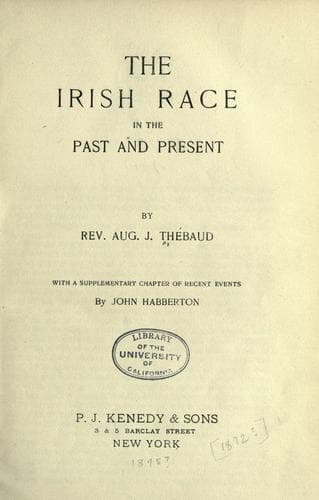
The Irish Race in the Past and the PresentThébaud, Augustus J.
History
The Irish Race in the Past and the Present
Thébaud, Augustus J.
Ireland -- History
Could such scenes as these have been surpassed by what took
place during the ninth, tenth, and eleventh centuries, in the
rude towns of Norway and Denmark, at the return of a powerful
seakong, with his large fleet, from a piratical excursion into
Southern Europe, when the spoils of many a Christian church and
wealthy house went to adorn the savage dwellings or those
barbarians? Adam of Bremen relates how he saw, with his own eyes,
the rich products of European art and industry accumulated in
the palace of the King of Denmark, and in the loathsome
dwellings of the nobility, or exposed for sale in the public
markets of the city.
But rapacity formed only one characteristic of the Scandinavians;
the mind of the people, moreover, showed itself,
notwithstanding the intricate and monstrous mythology which it
had created when pagan, of a rationalistic and anti-supernatural
tendency. Their mind was naturally systematic and reasoning; it
discussed spiritual matters in all their material aspects, and
thus gave rise to those speculations which soon became the
source of heresy. Hence, in England and the north of Germany,
the power of Rome was always called in question; and as the
English mind was altogether Scandinavian, while that of the
Germans was mixed with more of a southern disposition, the chief
trouble in Germany, between the empire and the Roman Church, lay
in the question of investitures, which combined a material and
spiritual aspect, whereas, in England, the quarrel was almost
invariably of a pecuniary nature, as, for instance, Peter's
pence.
Even in the most Catholic times, the English made a bitter
grievance of the levying of Peter's pence among them, and of the
giving of English benefices to prelates of other nations, which
also resolved itself into a question of revenue or money. And so
characteristic was the grievance of the whole nation that it was
restricted to no class, churchmen and monks being as loud in
their denunciations of Rome as the king and the nobles; and thus
the theological questions of the papal supremacy and of
ecclesiastical authority generally took with them quite a
material form. The diatribes of the Benedictine monk Matthew
Paris are well known, and their worldly spirit can only excite
in us pity that they should have been the chief cause of the
destruction of his own order in England and Ireland, and of the
total spoliation of the religious houses in whose behalf he
imagined that he wrote.
If the harms done by those contemptible wranglings about Peter's
pence and benefices had been confined to depriving the
pontifical exchequer of a revenue which was cheerfully granted
by other nations to aid the Father of the Faithful, the result
was to be regretted; but, after all, Christendom would not have
suffered in a much more sensible quarter. But in England the
question passed immediately to the election of bishops and
abbots, and thus the opposition to Rome gradually assumed much
vaster proportions.
Public-domain text, read in full here on John Shaqi.
Reviews
Reviews
No reviews yet
Be the first to share your thoughts on this work.
Elsewhere in the archive
Join the Discussion
Join the discussion
Sign in to leave a comment or review.
Sign InorCreate an account