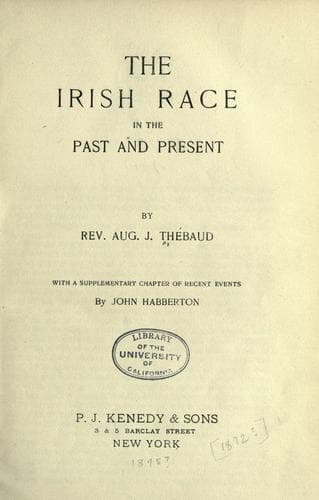
The Irish Race in the Past and the Present — John Shaqi
The Irish Race in the Past and the PresentThébaud, Augustus J.
History
The Irish Race in the Past and the Present
Thébaud, Augustus J.
Ireland -- History
The Celts could not easily brook such a change of social relations;
but, unable to cope against Roman power, they came, as usual, to
wrangle among themselves. The majority pronounced for another
chieftain, named Bogitar, and succeeded in forming a party in
Rome in his favor. Clodius, in an assembly of the Roman people,
obtained a decree confirmatory of his authority, and he took
possession of Pessinuntum, and of the celebrated Temple of Cybele.
The history of this branch of the Celts, nevertheless, did not
close with the evil fortunes of their last king. According to
Justinus, they swarmed all over Asia. Having lost their autonomy
as a nation, they became, as it were, the Swiss mercenaries of
the whole Orient. Egypt, Syria, Pontus, called them to their defence.
"Such," says Justinus, "was the terror excited by their name, and
the constant success of their undertakings, that no king on his
throne thought himself secure, and no fallen prince imagined himself
able to recover his power, except with the help of the ever-ready
Celts of those countries."
This short sketch suffices to show their power of expansion in
ancient times among thickly-settled populations. When we have
shown, farther on, how to-day they are spreading all over the
world, not looking to wild and desert countries, but to large
centres of population in the English colonies, we shall be able
to convince ourselves that they still present the same characteristic.
If they do not bear arms in their hands, it is owing to altered
circumstances; but their actual expansion bears a close resemblance
to that of ancient times, and the similarity of effect shows
the similarity of character.
We pass now to a new feature in the race, which has not, to our
knowledge, been sufficiently dwelt upon. All their migrations in
old times were across continents; and if, occasionally, they crossed
the Mediterranean Sea, they did so always in foreign vessels.
The Celtic race, as we have seen, occupied the whole of Western
Europe. They had, therefore, numerous harbors on the Atlantic,
and some excellent ones on the Mediterranean. Many passed the
greater portion of their lives on the sea, supporting themselves
by fishing; yet they never thought of constructing and arming
large fleets; they never fought at sea in vessels of their own,
with the single exception of the naval battle between Julius
Caesar and the Veneti, off the coast of Armorica, where, in one
day, the Roman general destroyed the only maritime armament which
the Celts ever possessed.
And even this fact is not an exception to the general rule; for
M. de Penhouet, the greatest antiquarian, perhaps, in Celtic lore
in Brittany, has proved that the Veneti of Western Gaul were not
really Celts, but rather a colony of Carthaginians, the only one
probably remaining, in the time of Caesar, of those once numerous
foreign colonies of the old enemies of Rome.
Public-domain text, read in full here on John Shaqi.
Reviews
Reviews
No reviews yet
Be the first to share your thoughts on this work.
Join the Discussion
Join the discussion
Sign in to leave a comment or review.
Sign InorCreate an account