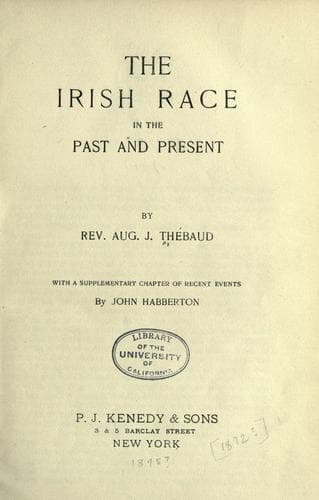
The Irish Race in the Past and the PresentThébaud, Augustus J.
History
The Irish Race in the Past and the Present
Thébaud, Augustus J.
Ireland -- History
As far as history can carry us back, the whole of Western Europe,
namely, Gaul, a part of Spain, Northern Italy, and what we call
to-day the British Isles, are found to be peopled by a race
apparently of the same origin, divided into an immense number of
small republics; governed patriarchally in the form of clans,
called by Julius Caesar, "Civitates." The Greeks called them Celts,
"Keltai." They do not appear to have adopted a common name for
themselves, as the idea of what we call nationality would never
seem to have occurred to them. Yet the name of Gaels in the British
Isles, and of Gauls in France and Northern Italy, seems identical.
Not only did they fill the large expanse of territory we have
mentioned, but they multiplied so fast, that they were compelled
to send out armed colonies in every direction, set as they were
in the midst of thickly-peopled regions.
We possess few details of their first invasion of Spain; but Roman
history has made us all acquainted with their valor. It was in the
first days of the Republic that an army of Gauls took possession
of Rome, and the names of Manlius and Camillus are no better known
in history than that of Brenn, called by Livy, Brennus. His celebrated
answer, "Vae victis," will live as long as the world.
Later on, in the second century before Christ, we see another army
of Celts starting from Pannonia, on the Danube, where they had
previously settled, to invade Greece. Another Brenn is at the head
of it. Macedonia and Albania were soon conquered; and, it is said,
some of the peculiarities of the race may still be remarked in many
Albanians. Thessaly could not resist the impetuosity of the invaders;
the Thermopylae were occupied by Gallic battalions, and that
celebrated defile, where three hundred Spartans once detained the
whole army of Xerxes, could offer no obstacle to Celtic bravery.
Hellas, sacred Hellas, came then under the power of the Gauls, and
the Temple of Delphi was already in sight of Brenn and his warriors,
when, according to Greek historians, a violent earthquake, the work
of the offended gods, threw confusion into the Celtic ranks, which
were subsequently easily defeated and destroyed by the Greeks.
A branch of this army of the Delphic Brenn had separated from
the main body on the frontiers of Thrace, taken possession of
Byzantium, the future Constantinople, and, crossing the straits,
established itself in the Heart of Asia Minor, and there founded
the state of Galatia, or Gallo-Greece, which so long bore their
name, and for several centuries influenced the affairs of Asia
and of the whole Orient, where they established a social state
congenial to their tastes and customs. But the Romans soon after
invading Asia Minor, the twelve clannish republics formerly
founded were, according to Strabo, first reduced to three, then
to two, until finally Julius Caesar made Dejotar king of the
whole country.
Public-domain text, read in full here on John Shaqi.
Reviews
Reviews
No reviews yet
Be the first to share your thoughts on this work.
Join the Discussion
Join the discussion
Sign in to leave a comment or review.
Sign InorCreate an account