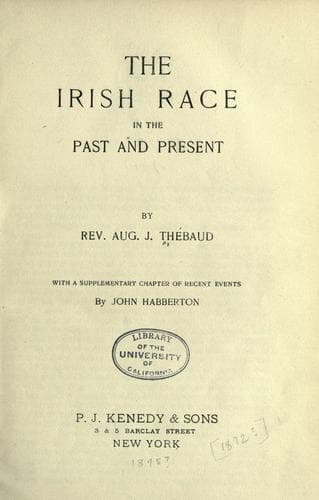
The Irish Race in the Past and the PresentThébaud, Augustus J.
History
The Irish Race in the Past and the Present
Thébaud, Augustus J.
Ireland -- History
Whatever may have been written derogatory to the institutions
existing in Europe during the mediaeval period, several great
facts, most favorable to the Catholic religion, have been
commonly admitted by Protestant writers, from which we select
two. The first of these was originally stated by M. Guizot, in
his "Civilization in Europe," namely, that the kingdom of France
was created by Christian bishops. Since that first admission,
other non-Catholic writers have gone further, and have felt
compelled to admit that, as a general rule, the modern European
nations have all been created, nurtured, fostered, by Catholic
bishops, and that the first free Parliaments of those nations
were, in fact, "councils of the Church," either of a purely
clerical character and altogether free from the intermixture of
lay elements, such as the Councils of Toledo, in Spain, or
acting in concert with the representatives of the various
classes in the nations.
The clergy, as all readers know, the clerks, were the first to
take the lead in civil affairs, being more enlightened than the
other classes, and holding in their body all the education of
the earlier times. It is unnecessary to add to this fact that,
among really Christian people, the voice of religion is listened
to before all others. And is it not to-day a well-ascertained
fact that, in the main, the influence exerted by the clergy on
the formation of modern European kingdoms was in favor of a well-
regulated freedom based on the first law--the law of God--that
primal source of true liberty and civilization? To the clergy,
certainly, and to the monks, is chiefly due the abolition of
slavery; and the bishops took a very active and prominent part
in the movements of the communes, to which the Third Estate owes
its birth.
A malignant ingenuity has been displayed by many writers, in
ransacking the pages of history, in order to fasten on certain
prelates of the Church charges of despotism and oppression. But,
apart from the fact that the narratives so carefully compiled
have, in many cases, turned out to be perversions of the truth,
and granting even that all these allegations are impartial and
true, the general tenor and tendency of the history of those
times is now admitted to be ample refutation of such accusations,
and impartial writers confess that the ecclesiastical influence,
during those ages, was clearly set against the oppression of
the people, and finally resulted in the formation of those
representative and moderate governments which are the boast of
the present age; and that the principles enunciated by the great
schoolmen, led by Thomas Aquinas, founded the order of society
on justice, religion, and right. The more history is studied
honestly, investigated closely, and viewed impartially, the more
plainly does the great fact shine forth that the Catholic
hierarchy, in the various European nations, constituted the
vanguard of true freedom and order.
Public-domain text, read in full here on John Shaqi.
Reviews
Reviews
No reviews yet
Be the first to share your thoughts on this work.
Elsewhere in the archive
Join the Discussion
Join the discussion
Sign in to leave a comment or review.
Sign InorCreate an account