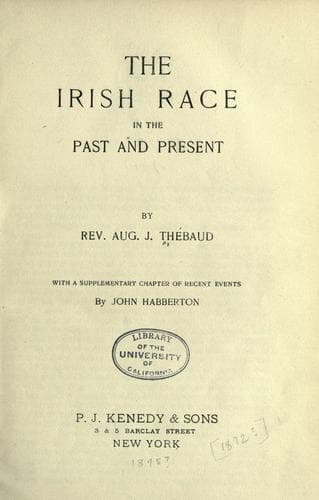
The Irish Race in the Past and the PresentThébaud, Augustus J.
History
The Irish Race in the Past and the Present
Thébaud, Augustus J.
Ireland -- History
With regard to the papal power, it is a curious instance of the
reversal of human judgment, and a very significant fact, that
those very Popes who, a hundred years ago, were looked upon,
even by Catholic writers, as the embodiment of supercilious
arrogance and sacrilegious presumption, namely, Gregory VII.,
Innocent III., and Boniface VIII., are now acknowledged to have
been the greatest benefactors to Europe in their time, and true
models of supreme Christian bishops.
But, if these two facts be admitted, the question recurs, How is
it that the governments of several kingdoms, and that of England
in particular, had, during the fifteenth and sixteenth centuries,
merged into complete and unalloyed despotism? As our present
interest in the question is restricted to England, we confine
ourselves to that country, and proceed to treat of it in a few
words.
Under the Tudors, the government grew to be altogether
irresponsible, personal, and despotic, chiefly because under
previous reigns, and constantly since the establishment of the
Norman line of kings, the authority of Rome, which formed the
only great counterpoise to kingly power at the time, had been
gradually undermined, while the bishops, being deprived of the
aid of the supreme Pontiff, had become mere tools in the hands
of the monarchs.
The particular shape which the opposition to Rome took in
England, compared with a similar opposition in Germany, has been
already touched upon; it was found to be involved chiefly in the
question of tribute-money and benefices, the latter being also
reduced to a money difficulty. It was seen that the monks and
the people sided generally with the kings, and gradually took a
dislike and mistrust to every thing coming from Rome; the
authority of the monarch, though not precisely strengthened
thereby, was left without the control of a superior tribunal to
direct him, and consequently the kings, if they chose, were left
to follow the impulse of their own caprice, which, according to
St. Thomas, forms the characteristic of tyranny.
Other causes, doubtless, contributed to pave the way for and
consolidate the despotism of the Kings of England. Among such
causes may be mentioned the extraordinary successes which
attended the English arms, led by their warrior kings in France,
and the frightful convulsions subsequently arising from the Wars
of the Roses; but we doubt not the one mentioned above was the
chief, and, of itself, would in the long-run have brought about
the same result.
Public-domain text, read in full here on John Shaqi.
Reviews
Reviews
No reviews yet
Be the first to share your thoughts on this work.
Elsewhere in the archive
Join the Discussion
Join the discussion
Sign in to leave a comment or review.
Sign InorCreate an account