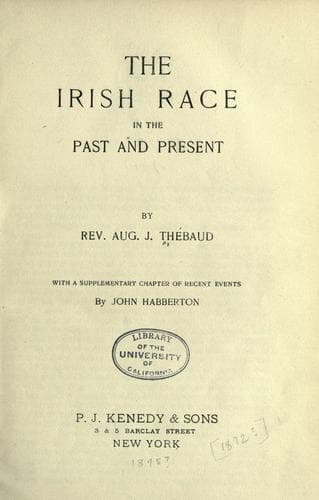
The Irish Race in the Past and the PresentThébaud, Augustus J.
History
The Irish Race in the Past and the Present
Thébaud, Augustus J.
Ireland -- History
Protestantism, therefore, was neither the growth of freedom in
England, nor did it plant freedom there at its introduction,
inasmuch as the royal power became more absolute than ever by
its predominance, and by the first principle which it laid down,
that the king was supreme in Church as well as in state. Can its
origin in England, then, be accounted for by the existence of a
higher civilization, anterior to it in point of time, out of
which it grew, or, at least, by a true aspiration toward such.
This question is as easy of solution as the first: There can be
no doubt that the nations which remained either entirely or in
the main faithful to the Church, in point of learning and
civilization, ranked far beyond the Northern nations, where
heresy so early found a permanent footing, and that in the South
also the tendencies toward a higher civilization were at that
time of a most marked and extraordinary character, so much so
that the reign of Leo X. has become a household phrase to
express the perfection of culture.
England, as a nation, was at that period only just beginning to
emerge from barbarism, and in fact was the last of the European
nations to adopt civilized customs and manners in the political,
civil, and social relations of life.
In politics she was, until that epoch, plunged in frightful
dynastic revolutions, and as yet had not learned the first
principles of good government. In civil affairs, her code was
the most barbarous, her feudal customs the most revolting, her
whole history the most appalling of all Christendom. In social
habits, she had scarcely been able to retain a few precious
fragments of good old Catholic times; and the fearful scenes
through which the nation had passed, which, according to J. J.
Rousseau, for once expressing the truth, render the reading of
that period of her history almost impossible to a humane man,
had sunk her almost completely in degradation. The reader will
understand that the England here spoken of is the England of
three centuries ago, and not of to-day.
If by civilization is understood learning and the fine arts,
what, in general phrase, is expressed by culture and refinement,
how could England compare at the time with Italy, Flanders,
Spain, France, all Latin or Celtic nations? How can it be
pretended that she was better fitted for the reception of a more
spiritual and elevating religion than any of the countries
mentioned?
Two great names may be brought forward as proving that the
expressions used are harsh and ill-founded--Shakespeare and
Milton; a third, Bacon, we omit for reasons which our space
forbids us to give.
Public-domain text, read in full here on John Shaqi.
Reviews
Reviews
No reviews yet
Be the first to share your thoughts on this work.
Elsewhere in the archive
Join the Discussion
Join the discussion
Sign in to leave a comment or review.
Sign InorCreate an account