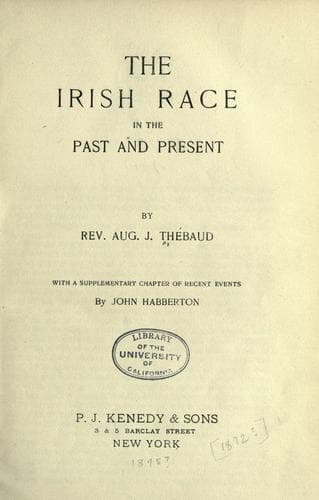
The Irish Race in the Past and the PresentThébaud, Augustus J.
History
The Irish Race in the Past and the Present
Thébaud, Augustus J.
Ireland -- History
Shakespeare, whose name may rank with those of Homer and Dante,
was not a product of those times. He was a gift of Heaven. At
any other epoch he would have been as great, perhaps greater.
What he received from his surroundings and from the
"civilization" with which he was blessed, he has handed down to
us in the uncouth form, the intricacy of plot and adventures,
which would have rendered barbarous a poet less naturally gifted.
And, although the question has never been definitely settled,
it is probable that he was born and lived a Catholic; and it is
strange how Elizabeth, who, tradition tells us, was present at
some of his plays, could endure his faithful portrayal of friars
and nuns, while she was persecuting their originals so
barbarously at the time; strangest of all, how she could bear to
look upon the true and noble image of Katherine of Aragon, whom
Henry in his good moment pronounces "the queen of earthly queens,
" contrasted with her own mother, to whom the shrewd old court
lady tells the story:
"There was a lady once ('tis an old story), That would not be a
queen, that would she not, For all the mud in Egypt :--Have you
heard it?"
Thus did Shakespeare contrast Elizabeth's wanton mother with the
noble woman whom Henry discarded for a toy. And some critics can
only find a reason for the composition of the "Merry Wives of
Windsor" and the "Sonnets" as an offering to the lewd queen.
Nothing more did he owe to his time.
And Milton, who, though his father was a Catholic, was himself a
rank Puritan, something of what we have said of Shakespeare may
be said of him. At all events, all his cultivation and taste
came from Italy. The poets of that really civilized country had
polished his uncouth nature, as it were in spite of itself, and
added to the depth of his wonderful genius the beauty and soft
harmony of verse that ever flowed freely, and the strength of a
nervous and sonorous prose.
Now comes the question: If the origin of Protestantism in
England cannot be attributed to freedom and civilization, may it
not, at least, be maintained that the natural result of
Protestantism was the acquisition of true freedom and of a
higher civilization? Is it not true that to-day Protestant
nations are in advance of others in both these respects? And to
what other cause can such advancement be ascribed than to the
"reformed religion?" Is it not the freedom which has come to the
human mind, after the rejection of the yoke of spiritual
authority, and the proclamation of the rights of individual
reason, that has brought about the present advanced state of
affairs
Public-domain text, read in full here on John Shaqi.
Reviews
Reviews
No reviews yet
Be the first to share your thoughts on this work.
Elsewhere in the archive
Join the Discussion
Join the discussion
Sign in to leave a comment or review.
Sign InorCreate an account