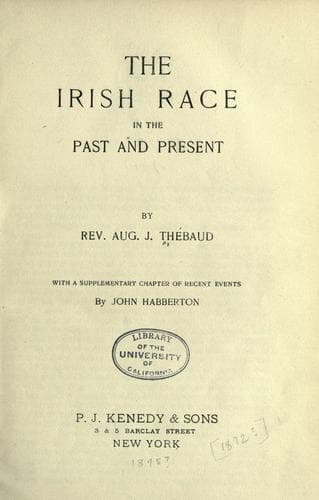
The Irish Race in the Past and the PresentThébaud, Augustus J.
History
The Irish Race in the Past and the Present
Thébaud, Augustus J.
Ireland -- History
We know all these fine-sounding phrases which are so
continuously dinned into our ears, and republished day after day
in a thousand forms. The question, we admit, is not so easy of
solution as the first, and might, indeed, without suspicion of
evasion, be discarded as not coming under the head of this
chapter, which spoke of origin and not of consequences.
Nevertheless, a few words may be devoted to the subject, to
prove that the answer must still be in the negative.
The first result of Protestantism was undoubtedly to extinguish
as completely as possible the remaining sparks of truly liberal
thought promulgated in Europe by the Catholic doctors of the
middle ages. Wherever the new doctrines spread, secular rulers
were not only freed from pontifical control, but were themselves
invested with supreme ecclesiastical power. The effective check
which the paternal and bold voice issuing from the Vatican had
exercised on kings and princes was in a moment taken away. In
Germany, England, and Scandinavia, the kings and petty princes,
and dukes even, became each so many popes in their own dominions.
And this took place with the consent and frequently at the
earnest request of the Reformers.
Even the European states which did not fall away from the old
faith of Christendom took advantage, it might almost be said, of
the difficult position in which the Holy Father found himself,
to countenance new doctrines with respect to the limits of the
authority of the Supreme Pontiff; and the new errors which so
suddenly appeared in France and elsewhere, during the prevalence
and at the extinction of the great schism, limiting the power of
the Popes in many matters where it had been considered binding,
broke out again, in France principally, under the lead of
Protestant or Erastian parliamentarians and legists, under the
name of Gallican liberties--pretended liberties, which would
really make the Church a subordinate adjunct of the State,
instead of what it is, a spiritual living body ruled exclusively
by a spiritual head.
How could the cause of true liberty in Europe be promoted by
such altered circumstances as these?--to say nothing of the
disastrous imprudence with which those blind rulers and so-
called theologians took away the key-stone of the European
social edifice, which grew weaker from that day forth, until now
we see it tottering to its fall.
The introduction of Protestantism, then, was one of the chief
causes of the change by which a much greater personal power was
transferred to the hands of the sovereign than he had ever
before held, and it is no surprise to see the absolutism of
emperors and kings, in Christian Europe, date from its coming.
Public-domain text, read in full here on John Shaqi.
Reviews
Reviews
No reviews yet
Be the first to share your thoughts on this work.
Elsewhere in the archive
Join the Discussion
Join the discussion
Sign in to leave a comment or review.
Sign InorCreate an account