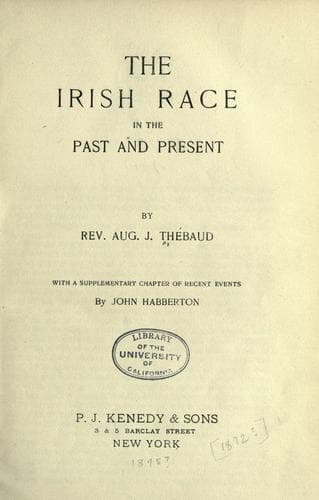
The Irish Race in the Past and the PresentThébaud, Augustus J.
History
The Irish Race in the Past and the Present
Thébaud, Augustus J.
Ireland -- History
As time passed on, the cause acting on a larger scale, embracing
a wider circumference, and drawing within its circle vaster
territories, the world saw absolute rule established in England,
France, Spain, and Germany. Previous to the sixteenth century,
the word 'absolutism' was unknown in Christendom, as was the
doctrine of the "divine right of kings" understood and preached
as it has since been in England.
But, to furnish details which should render these reflections
more striking, would require an unravelling of the whole tangled
skein of history during those times.
Nevertheless, we must come to consider the last refuge of
Protestant liberalism. Did not the Reformation really emancipate
modern nations, and gradually bring about the whole system of
representative governments, which, starting from England, have
now, in fact, become, more or less, general throughout Europe?
Our answer is, Yes and No. It may be granted that Protestantism
did give rise to a certain kind of liberalism very prevalent in
our days; but such liberalism is very far from bestowing on
nations true liberty and stability; hence their constant
agitation, and the perils of society which threaten all, even
the specially favored Protestant nations themselves as much as
any.
It was indeed the new doctrines which brought about the
"Commonwealth" in England, and the subsequent Revolution of 1688;
between which two events, however, great differences exist.
The destruction of monarchy under and in the person of Charles I.
was the just retribution dealt by Providence to the English
kings, who had been the first openly to shake off from a great
nation the wise and beneficent yoke of Rome. At all events, one
thing is certain, that under the "Protector," the child of the
Revolution, as little as under the Protestant Tudors, could the
English scarcely be regarded as freemen.
Cromwell banished from their hall the representatives of the
people. He could scarcely find epithets opprobrious enough for
Magna Charta, which the people considered, and rightly, as the
palladium of English liberty. In his scornful order to "take
away that bawble," though the "bawble" immediately referred to
was the Speaker's mace, the word meant the freedom of the nation.
He was as absolute a monarch as ever ruled England. The liberty
enjoyed under his regime was as meaningless for every class as
for the Catholics, whom he more immediately oppressed, and was
ill compensated for by the material prosperity which his genius
knew so well how to secure.
It was his despotic rule, in fact, and the fear of anarchy which
affrighted the minds of the people at his death--the dread of a
government of rival soldiers--which rendered so easy the
triumphant restoration of the worthless Stuarts, in the person
of the most worthless of them all, Charles II.
Public-domain text, read in full here on John Shaqi.
Reviews
Reviews
No reviews yet
Be the first to share your thoughts on this work.
Elsewhere in the archive
Join the Discussion
Join the discussion
Sign in to leave a comment or review.
Sign InorCreate an account