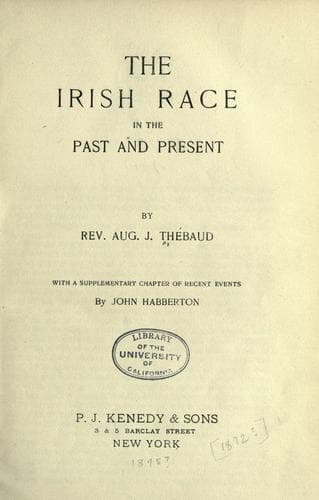
The Irish Race in the Past and the PresentThébaud, Augustus J.
History
The Irish Race in the Past and the Present
Thébaud, Augustus J.
Ireland -- History
The true constitutional liberty of which England may fairly
boast was the work of a long series of years subsequent to the
Revolution of 1688. It was the work of the whole eighteenth
century, in fact, and was grounded on the fragments of old
Catholic doctrines and customs. In no sense can it be called the
result of Protestantism, save as coming after it in point of
time.
Whoever is acquainted with the state of religion and society in
England, during the latter part of the seventeenth and the whole
of the eighteenth century, needs not to be told that, among the
ruling classes, faith in a revealed religion had ceased to exist.
The yoke of Rome once shaken off, the human mind was quick to
draw all the consequences of the principle of entire
independence in religious matters. Tindal, Collins, Hobbes,
Shaftesbury, and other philosophers, had openly denounced
revelation, and that portion of the nation which esteemed itself
enlightened embraced their new doctrines. It would be false to
imagine that, in 1700 and afterward, the English were as firm
believers in the Church of England's Thirty-nine Articles as
they seemed to be at the beginning of this century. The whole of
the last century was for all Europe, with the exception of the
two peninsulas of Italy and Spain, a period of avowed disbelief.
Even Presbyterian Scotland did not escape the contagion, and
some theologians and preachers of the Kirk at that time are now
praised for their liberal views of religion, that is, for their
want of real faith. The influence of Wesley and his fellow-
workers on the English mind, and the dread of the spread of
French infidelity and jacobinism, were more extensive and
effectual than people are apt to imagine; and there is no doubt
that, seventy years ago England was far more of a believing
country than she had been for a hundred years before.
But, if even Scotch Presbyterian ministers and Church of England
men, such as Laurence Sterne, were unworthy of the name of
Christian, what are we to think of those who had to profess no
outward faith in Christianity, because of ministerial offices?
There is no doubt that, in the mass, they were almost completely
void of any faith in revealed religion.
To such men as these is England indebted for the development of
her constitution. If Protestantism had any share in it at all,
it did not go beyond preparing the way for the destruction of
Christianity in the mind and heart of the people; or, rather,
constitutional liberty in England has no connection whatever
with religion. The English, left to their own ingenuity and
skill, displayed a vast amount of statesmanlike qualities in
devising for themselves a system of check and counter-check,
which protected the subject and defined the rights of the ruler;
and this gave the nation an undoubted superiority over their
neighbors on the Continent. But it cannot be attributed, except
in a very remote manner, to the Protestant doctrine of the
independence of the human mind.
Public-domain text, read in full here on John Shaqi.
Reviews
Reviews
No reviews yet
Be the first to share your thoughts on this work.
Elsewhere in the archive
Join the Discussion
Join the discussion
Sign in to leave a comment or review.
Sign InorCreate an account