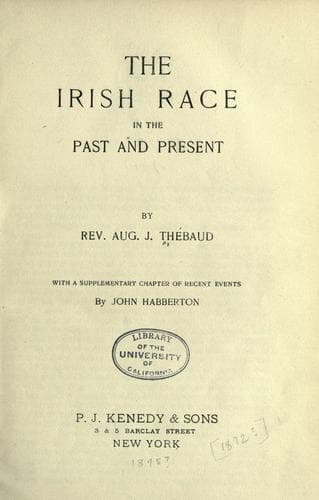
The Irish Race in the Past and the PresentThébaud, Augustus J.
History
The Irish Race in the Past and the Present
Thébaud, Augustus J.
Ireland -- History
Were we to examine the effect which the example of England
produced on other nations, we should find that, instead of
spreading liberty, it was the cause of the diffusion of an
unbridled license under the name of liberalism.
In England itself; the lower orders of society having been kept
in ignorance, and consequently in subjection to the ruling
classes, and the latter finding it to their interest to preserve
order and stability in the state, no frightful commotions could
ensue to threaten the destruction of society.
In Continental countries, the middle and even the lowest classes
were more readily caught by doctrines which, when kept within
due bounds, may be promotive of exterior prosperity, but which,
pushed to their extremes and logical consequences, may embroil
the whole nation in revolution and calamities.
Such has been the case in our own days, and in days immediately
preceding our own; and England is now experiencing the recoil of
those convulsions, and seems on the eve of being convulsed
herself more terribly, perhaps, than any other nation has yet
been.
These few reflections must suffice, as to extend them would go
beyond our present scope. But now comes the question, Why was
Ireland unprepared for the reception of Protestantism? Why did
she reject it absolutely and permanently?
According to the theorists who attribute the success of
Protestantism in the North of Europe to a higher civilization
and a more ardent love of freedom, the contrary characteristics
should distinguish those nations which remained faithful to the
Church, and particularly the Irish. Was the lack of a higher
civilization and more ardent love for freedom really the cause,
then, for Ireland's undergoing so many fearful sacrifices merely
for the sake of her religion?
We should not dread entering upon a comparison of the
Scandinavian and Celtic races in these two articular points, as
they existed at the time of the Tudors. We are confident that a
detailed survey of both would result in a glorious vindication
of the Irish character, although, owing to six hundred years of
cruel wars with Dane and Anglo-Norman, the actual prosperity of
the country was far inferior to that of England. But the outline
of so vast a subject must content us here.
In judging of the elevation of a nation's sentiments, the first
thing that strikes us is the motive assigned by the Irish
representatives for refusing to pass the bill of supremacy.
"Five or six changes of religion in twelve years were too much
for conscientious people." Such was the answer sent back to
Elizabeth, and spoken as though easy of comprehension. Had they
deemed that their language could have been misunderstood, they
would undoubtedly have expressed themselves in stronger terms.
Public-domain text, read in full here on John Shaqi.
Reviews
Reviews
No reviews yet
Be the first to share your thoughts on this work.
Elsewhere in the archive
Join the Discussion
Join the discussion
Sign in to leave a comment or review.
Sign InorCreate an account