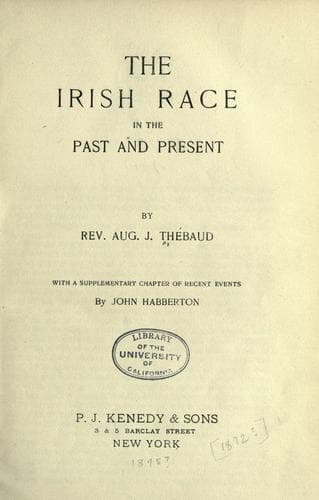
The Irish Race in the Past and the PresentThébaud, Augustus J.
History
The Irish Race in the Past and the Present
Thébaud, Augustus J.
Ireland -- History
Instead of enabling the land-owners of Connaught to obtain a new
title by a new enrolment, Strafford, with the connivance of
Charles, devised a project which would have enabled the king to
dispose of the whole province to the enriching of his exchequer.
This project consisted in throwing open the whole territory to
the court of "defective titles." To legalize this spoliation,
the parchment grant, five hundred years old, given to Roderic
O'Connor and Richard de Burgo, by Henry II., was set up as
rendering invalid the claims of immemorial possession by the
Irish, although confirmed by recent compositions.
In the counties of Roscommon, Mayo, and Sligo, juries were found
for the crown. The honesty and courageous resistance of a Galway
jury prevented the carrying out of the measure in that county.
Strafford resented this rebuff deeply; and the brave Galway
jurors were punished without mercy for their "contumacy," for
they had been told openly to find for the king. Compelled to
appear in the Castle chamber, they were each fined four thousand
pounds, their estates seized, and themselves imprisoned until
their fines should be paid; while the sheriff, who was also
fined to the same amount, not being able to pay, died in prison.
Such were a few of the "graces" granted the Irish on the
accession of Charles I.
Meanwhile, the king's difficulties with his English subjects
drove him to turn for hope to the Scotch, upon whom he had
attempted to force Episcopalianism. The resistance of the Scotch,
and the celebrated Covenant by which they bound themselves, are
well known. Charles, finally, granted the Covenanters not only
liberty of conscience, but even the religious supremacy of
Presbyterianism, paying their army, moreover, for a portion of
the time it passed under service in the rebellion against
himself.
The example of the Scotch was certainly calculated to inflame
the Irish with ardor, and drive them likewise into rebellion.
What was the oppression of Scotland compared to that under which
Ireland had so long groaned? Surely the final attempt of the
chief minister of Charles to rob them of the one province which
had hitherto escaped, was enough to open their eyes, and convert
their faith in the Stuart dynasty into hatred and determined
opposition. Yet were they on the eve of carrying their devotion
to this faithless and worthless line to the height of heroism.
The generosity of the nature which is in them could find an
excuse for Charles. "He would have done us right," they thought,
"had he been left free." From the rebellion of his subjects, in
England and Scotland, they could only draw one conclusion--that
he was the victim of Puritanism, for which they could entertain
no feeling but one of horror; and it is a telling fact that
their attachment to their religion kept them faithful to the
sovereign to whom they had sworn their allegiance, however
unworthy he might be.
Public-domain text, read in full here on John Shaqi.
Reviews
Reviews
No reviews yet
Be the first to share your thoughts on this work.
Elsewhere in the archive
Join the Discussion
Join the discussion
Sign in to leave a comment or review.
Sign InorCreate an account