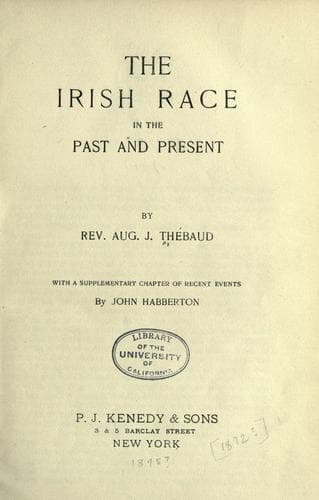
The Irish Race in the Past and the PresentThébaud, Augustus J.
History
The Irish Race in the Past and the Present
Thébaud, Augustus J.
Ireland -- History
By the death of Owen Roe O'Neill just at that time, Ireland was
left without a leader fit to cope with the great republican
general. The country had already been devastated by Coote, Munro,
St. Leger, and other Scotch and English Puritans; but the
massacres which, until the coming of Cromwell, had been, at
least, only local and checked by the troops of Owen Roe, soon
extended throughout the island, unarrested by any forces in the
field. The Cromwellian soldiers, not content with the character
of warriors, came as "avengers of the Lord," to destroy an
"idolatrous people."
That their real design was to exterminate the nation, and use
the opportunity which then presented itself for that purpose,
there can by no doubt. It was only after a fair trial that the
project was found to be impossible, and that other expedients
were devised. Coote had previously acted with this design in
view, as is now an ascertained fact, and had been encouraged in
the course he pursued by the Dublin government. 1 (1 See Matthew
O'Connor's "Irish Catholics.") The same might be shown of St.
Leger, in Munster, toward the beginning of the insurrection. At
all events, all doubt in the matter, if any existed, ceased with
the landing of Cromwell in 1649, when the real object of the war
at once showed itself everywhere.
The result of this man's policy has been painted by Villemain,
in his "Histoire de Cromwell," in a sentence: "Ireland became a
desert which the few remaining inhabitants described by the
mournful saying, 'There was not water enough to drown a man, not
wood enough to hang him, not earth enough to bury him.'"
The French writer attributes to the whole island what was said
of only a part of it. To this day, the name of Cromwell is
justly execrated in Ireland, and "the curse of Cromwell " is one
of the bitterest which can be invoked upon a person's head. But,
at present, the fidelity of the Irish to the Stuarts concerns us,
and a few reflections will put it in a strong but true light
before us.
Public-domain text, read in full here on John Shaqi.
Reviews
Reviews
No reviews yet
Be the first to share your thoughts on this work.
Elsewhere in the archive
Join the Discussion
Join the discussion
Sign in to leave a comment or review.
Sign InorCreate an account