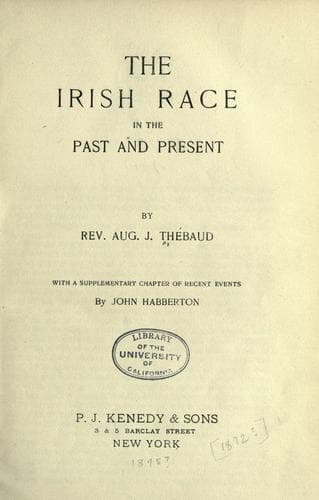
The Irish Race in the Past and the PresentThébaud, Augustus J.
History
The Irish Race in the Past and the Present
Thébaud, Augustus J.
Ireland -- History
The knowledge which Julius Caesar possessed of the Druids and of
their literary system was very incomplete; yet he presents to his
readers a truly grand spectacle, when he speaks of their numerous
schools, frequented by an immense number of the youths of the
country, so different from those of Rome, in which his own mind
had been trained--"Ad has magnus adolescentium numerus disciplinae
causa concurrit:" when he mentions the political and civil subjects
submitted to the judgment of literary men--"de omnibus controversiis
publicis privatisque constituunt. ... Si de hereditate, si de
finibus controversia est, iidem decernunt:" when he states the
length of their studies--"annos nonnulli vicenos in disciplina
permanent:" when he finally draws a short sketch of their course
of instruction-- "multa de sideribus atque eorum motu, de mundi
ac terrarum magnitudine, .... disputant juventutique tradunt."
But, unfortunately, the great author of the "Commentaries" had
not sufficiently studied the social state of the Celts in Gaul
and Britain; he never mentions the clan institution, even when
he speaks of the feuds--factiones--which invariably split their
septs--civitates--into hostile parties. In his eleventh chapter,
when describing the contentions which were constantly rife in
the cities, villages, even single houses, when remarking the
continual shifting of the supreme authority from the Edui to the
Sequani, and reciprocally, he seems to be giving in a few phrases
the long history of the Irish Celts; yet he does not appear to
be aware of the cause of this universal agitation, namely, the
clan system, of which he does not say a single world. How could
he have perceived the effect of that system on their literature
and art?
To understand it at once it suffices to describe in a few words
the various branches of studies pursued by their learned men;
and, as we are best acquainted with that portion of the subject
which concerns Ireland, we will confine ourselves to it. There
is no doubt the other agglomerations of Celtic tribes, the Gauls
chiefly, enjoyed institutions very similar, if not perfectly alike.
The highest generic name for a learned man or doctor was "ollamh."
These ollamhs formed a kind of order in the race, and the
privileges bestowed on them were most extensive. "Each one of
them was allowed a standing income of twenty-one cows and their
grasses," in the chieftain's territory, besides ample refections
for himself and his attendants, to the number of twenty-four,
including his subordinate tutors, his advanced pupils, and his
retinue of servants. He was entitled to have two hounds and six
horses, . . . and the privilege of conferring a temporary sanctuary
from injury or arrest by carrying his wand, or having it carried
around or over the person or place to be protected. His wife also
enjoyed certain other valuable privileges.--(Prof. E. Curry, Lecture I.)
Public-domain text, read in full here on John Shaqi.
Reviews
Reviews
No reviews yet
Be the first to share your thoughts on this work.
Join the Discussion
Join the discussion
Sign in to leave a comment or review.
Sign InorCreate an account