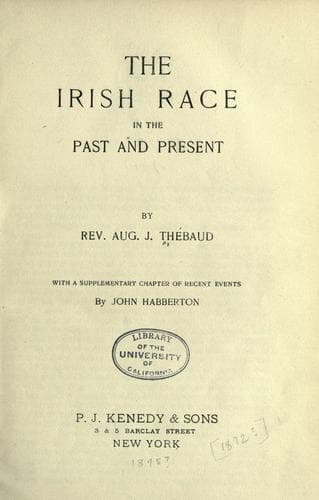
The Irish Race in the Past and the PresentThébaud, Augustus J.
History
The Irish Race in the Past and the Present
Thébaud, Augustus J.
Ireland -- History
But to reach that degree he was to prove for himself, purity of
learning, purity of mouth (from satire), purity of hand (from
bloodshed), purity of union (in marriage), purity of honesty (from
theft), and purity of body (having but one wife).
With the Celts, therefore, learning constituted a kind of priesthood.
These were his moral qualifications. His scientific attainments
require a little longer consideration, as they form the chief
object we have in view.
They may at the outset be stated in a few words. The ollamh was
"a man who had arrived at the highest degree of historical
learning, and of general literary attainments. He should be an
adept in royal synchronisms, should know the boundaries of all
the provinces and chieftaincies, and should be able to trace the
genealogies of all the tribes of Erin up to the first man.--(Prof. Curry,
Lecture X.)
Caesar had already told us of the Druids, "Si de hereditate, si de
finibus controversia est iidem decernunt." In this passage he gives
us a glimpse of a system which he had not studied sufficiently to
embrace in its entirety.
The qualifications of an ollamh which we have just enumerated, that
is to say, of the highest doctor in Celtic countries, already prove
how their literature grew out of the clan system.
The clan system, of which we shall subsequently speak more at
length, rested entirely on history, genealogy, and topography. The
authority and rights of the monarch of the whole country, of the
so-called kings of the various provinces, of the other chieftains in
their several degrees, finally, of all the individuals who composed
the nation connected by blood with the chieftains and kings,
depended entirely on their various genealogies, out of which grew
a complete system of general and personal history. The conflicting
rights of the septs demanded also a thorough knowledge of topography
for the adjustment of their difficulties. Hence the importance to
the whole nation of accuracy in these matters, and of a competent
authority to decide on all such questions.
But in Celtic countries, more than in all others, topography was
connected with general history, as each river or lake, mountain
or hill, tower or hamlet, had received a name from some historical
fact recorded in the public annals; so that even now the geographical
etymologies frequently throw a sudden and decisive light on disputed
points of ancient history. So far, this cannot be called a literature;
it might be classed under the name of statistics, or antiquarian lore;
and if their history consisted merely of what is contained in the old
annals of the race, it would be presumptuous to make a particular
alllusion to their literature, and make it one of the chief
characteristics of the race. The annals, in fact, were mere
chronological and synchronic tables of previous events.
Public-domain text, read in full here on John Shaqi.
Reviews
Reviews
No reviews yet
Be the first to share your thoughts on this work.
Join the Discussion
Join the discussion
Sign in to leave a comment or review.
Sign InorCreate an account