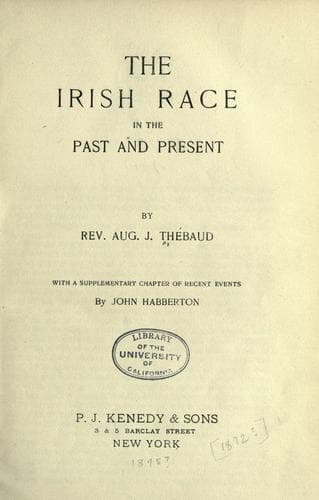
The Irish Race in the Past and the PresentThébaud, Augustus J.
History
The Irish Race in the Past and the Present
Thébaud, Augustus J.
Ireland -- History
According to McFirbis, in his book of genealogies, "the historians
were so anxious and ardent to preserve the history of Erin, that
the description they have left us of the nobleness and dignified
manners of the people, should not be wondered at, since they did
not refrain from writing even of the undignified artisans, and of
the professors of the healing and building arts of ancient times
--as shall be shown below, to prove the fidelity of the historians,
and the errors of those who make such assertions, as, for instance,
that there were no stone buildings in Erin before the coming of the
Danes and Anglo-Normans.
"Thus saith an ancient authority: `The first doctor, the first
builder, and the first fisherman, that were ever in Erin were--
Capa, for the healing of the sick,
In his time was all-powerful;
And Luasad, the cunning builder,
And Laighne, the fisherman.'"
So speaks McFirbis in his quaint and picturesque style.
The literature of the Celts was, therefore, impressed with the
character of realistic universality, which has been the great boast
of the romantic school. It did not concern itself merely with the
great and powerful, but comprised all classes of people, and tried
to elevate what is of itself undignified and common in human
society. This is no doubt the meaning of the quotation just cited.
Among the Celts, then, each clan had his historian to record the
most minute details of every-day history, as well as every fact
of importance to the whole clan, and even to the nation at large;
and thus we may see how literature with them grew naturally out
of their social system. The same may not appear to hold good at
first sight with the other classes of literary men; yet it would
be easy to discover the link connecting them all, and which was
always traditional or matter-of-fact, if we may use that expression.
The next SUB-ORDER was that of File, which is generally translated
poet, but its meaning also involves the idea of philosophy or
wisdom added to that of poetry.
The File among the Celts was, after all, only an historian writing
in verse; for all their poetry resolved itself into annals, "poetic
narratives" of great events, or finally "ballads."
It is well known that among all nations poetry has preceded prose;
and the first writers that appeared anywhere always wrote in verse.
It seems, therefore, that in Celtic tribes the order of File was
anterior in point of time to that of Shanachy, and that both must
have sprung naturally from the same social system. Hence the
monarch of the whole nation had his poets, as also the provincial
kings and every minor chieftain.
In course of time their number increased to such an extent in
Ireland, that at last they became a nuisance to be abated.
Public-domain text, read in full here on John Shaqi.
Reviews
Reviews
No reviews yet
Be the first to share your thoughts on this work.
Join the Discussion
Join the discussion
Sign in to leave a comment or review.
Sign InorCreate an account