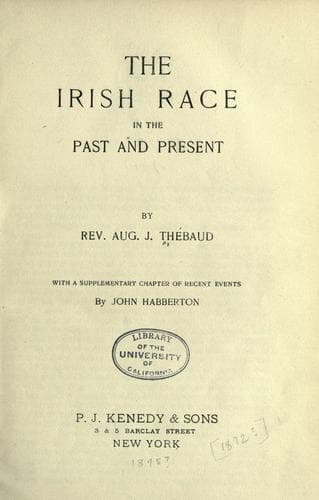
The Irish Race in the Past and the PresentThébaud, Augustus J.
History
The Irish Race in the Past and the Present
Thébaud, Augustus J.
Ireland -- History
"It is said that in the days of Connor McNassa--several centuries
before Christ--there met once 1,200 poets in one company; another
time 1,000, and another 700, namely, in the days of Aedh McAinmire
and Columcille, in the sixth century after our Saviour. And
between these periods Erin always thought that she had more of
learned men than she wanted; so that from their numbers and the
tax their support imposed upon the public, it was attempted to
banish them out of Erin on three different occasions; but they
were detained by the Ultonians for hospitality's sake. This is
evident from the Amhra Columcille (panegyric of St. Columba). He
was the last that kept them in Ireland, and distributed a poet to
every territory, and a poet to every king, in order to lighten the
burden of the people in general. So that there were people in their
following, contemporary with every generation to preserve the
history and events of the country at this time. Not these alone,
but the kings, and, saints, and churches of Erin preserved their
history in like manner."
From this curious passage of McFirbis, it is clear that the Celtic
poets proposed to themselves the same object as the historians did;
only that they wrote in verse, and no doubt allowed themselves more
freedom of fancy, without altering the facts which were to them of
paramount importance.
McFirbis, in the previous passage, gives us a succinct account
of the action of Columbkill in regard to the poets or bards of
his time. But we know many other interesting facts connected
with this event, which must be considered as one of the most
important in Ireland during the sixth century. The order of poets
or bards was a social and political institution, reaching back in
point of time to the birth of the nation, enjoying extensive
privileges, and without which Celtic life would have been deprived
of its warmth and buoyancy. Yet Aed, the monarch of all Ireland,
was inclined to abolish the whole order, and banish, or even outlaw,
all its members. Being unable to do it of his own authority, he
thought of having the measure carried in the assembly of Drumceit,
convened for the chief purpose of settling peacefully the relations
of Ireland with the Dalriadan colony established in Western
Scotland a hundred years before. Columba came from Iona in behalf
of Aidan, whom he had crowned a short time previously as King
of Albania or Scotland. It seems that the bards or poets were
accused of insolence, rapacity, and of selling their services
to princes and nobles, instead of calling them to account for
their misdeeds.
Columba openly undertook their defence in the general assembly of
the nation. Himself a poet, he loved their art, and could not
consent to see his native country deprived of it. Such a deprivation
in his eyes would almost have seemed a sacrilege.
Public-domain text, read in full here on John Shaqi.
Reviews
Reviews
No reviews yet
Be the first to share your thoughts on this work.
Join the Discussion
Join the discussion
Sign in to leave a comment or review.
Sign InorCreate an account