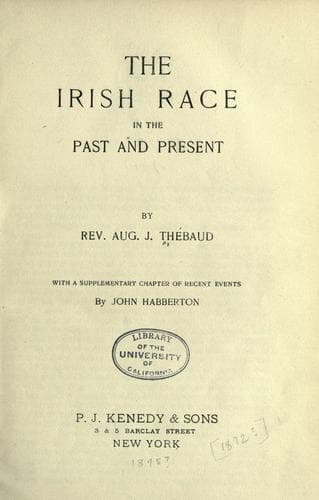
The Irish Race in the Past and the PresentThébaud, Augustus J.
History
The Irish Race in the Past and the Present
Thébaud, Augustus J.
Ireland -- History
"He represented," says Montalembert, "that care must be taken not
to pull up the good corn with the tares, that the general exile
of the poets would be the death of a venerable antiquity, and of
that poetry so dear to the country, and so useful to those who
knew how to employ it. The king and assembly yielded at length,
under condition that the number should be limited, and their
profession laid under certain rules."
Dallan Fergall, the chief of the corporation, composed his "Amhra,"
or Praise of Columbkill, as a mark of gratitude from the whole
order. That the works of Celtic poets possessed real literary merit,
we have the authority of Spenser for believing. The author of the
"Faerie Queene" was not the friend of the Irish, whom he assisted
in plundering and destroying under Elizabeth. He could only judge
of their books from English translations, not being sufficiently
acquainted with the language to understand its niceties. Yet he
had to acknowledge that their poems "savoured of sweet wit and
good invention, but skilled not of the goodly ornaments of poetry;
yet were they sprinkled with some pretty flowers of their natural
device, which gave good grace and comeliness to them."
He objected, it is true, to the patriotism of their verse, and
pretended that they "seldom choose the doings of good men for the
argument of their poems," and became "dangerous and desperate in
disobedience and rebellious daring." But this accusation is high
praise in our eyes, as showing that the Irish bards of Spenser's
time praised and glorified those who proved most courageous in
resisting English invasion, and stood firmly on the side of their
race against the power of a great queen.
A poet, it seems, required twelve years of study to be master of
his art. One-third of that time was devoted to practising the
"Teinim Laegha," by which he obtained the power of understanding
every thing that it was proper for him to speak of or to say. The
next third was employed in learning the "Imas Forosnadh," by which
he was enabled to communicate thoroughly his knowledge to other
pupils. Finally, the last three years were occupied in "Dichedal,"
or improvisation, so as to be able to speak in verse on all subjects
of his study at a moment's notice.
There were, it appears, seven kinds of verse; and the poet was
bound to possess a critical knowledge of them, so as to be a judge
of his art, and to pronounce on the compositions submitted to him.
If called upon by any king or chieftain, he was required to relate
instantly, seven times fifty stories, namely, five times fifty
prime stories, and twice fifty secondary stories.
The prime stories were destructions and preyings, courtships,
battles, navigations, tragedies or deaths, expeditions, elopements,
and conflagrations.
Public-domain text, read in full here on John Shaqi.
Reviews
Reviews
No reviews yet
Be the first to share your thoughts on this work.
Join the Discussion
Join the discussion
Sign in to leave a comment or review.
Sign InorCreate an account