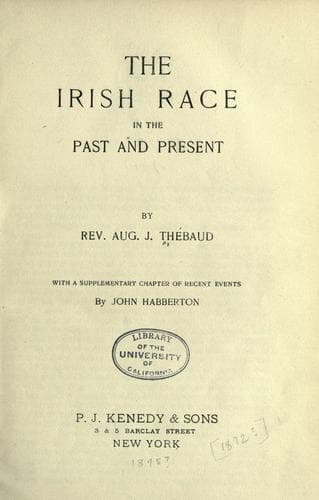
The Irish Race in the Past and the Present — John Shaqi
The Irish Race in the Past and the PresentThébaud, Augustus J.
History
The Irish Race in the Past and the Present
Thébaud, Augustus J.
Ireland -- History
That all Celtic tribes were fond of it and cultivated it thoroughly
we have the assertion of all ancient writers who spoke of them.
According to Strabo, the Third order of Druids was composed of
those whom he calls _Umnetai_. What were their instruments is not
mentioned; and we can now form no opinion of their former musical
taste from the rude melodies of the Armoricans, Welsh, and Scotch.
From time immemorial the Irish Celts possessed the harp. Some
authors have denied this; and from the fact that the harp was
unknown to the Greeks and Romans, and that the Gauls of the time
of Julius Caesar do not seem to have been acquainted with it, they
conclude that it was not purely native to any of the British islands.
But modern researches have proved that it was certainly used in
Erin under the first successors of Ugaine Mor, who was monarch.
--Ard-Righ--about the year 633 before Christ, according to the
annals of the Four Masters. The story of Labhraid, which seems
perfectly authentic, turns altogether on the perfection with
which Craftine played on the harp. From that time, at least, the
instrument became among the Celts of Ireland a perpetual source
of melody.
To judge of their proficiency in its use, it is enough to know to
what degree of perfection they had raised it. Mr. Beauford, in
his ingenious and learned treatise on the music of Ireland, as
cultivated by its bards, creates genuine astonishment by the
discoveries into which his researches have led him.
The extraordinary attention which they paid to expression and
effect brought about successive improvements in the harp, which
at last made it far superior to the Grecian lyre. To make it
capable of supporting the human voice in their symphonies, they
filled up the intervals of the fifths and thirds in each scale,
and increased the number of strings from eighteen to twenty-eight,
retaining all the original chromatic tones, but reducing the
capacity of the instrument; for, instead of commencing in the lower
E in the bass, it commenced in C, a sixth above, and terminated
in G in the octave below; and, in consequence, the instrument
became much more melodious and capable of accompanying the human
voice. Malachi O'Morgair, Archbishop of Armagh, introduced other
improvements in it in the twelfth century. Finally, in later times,
its capacity was increased from twenty-eight strings to thirty-three,
in which state it still remains.
Public-domain text, read in full here on John Shaqi.
Reviews
Reviews
No reviews yet
Be the first to share your thoughts on this work.
Join the Discussion
Join the discussion
Sign in to leave a comment or review.
Sign InorCreate an account