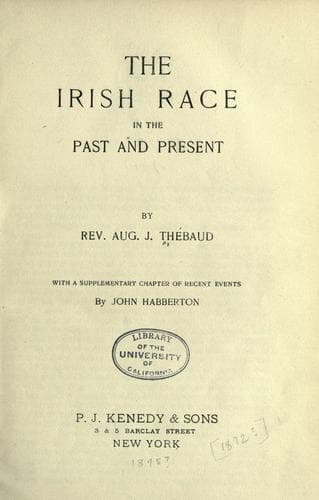
The Irish Race in the Past and the PresentThébaud, Augustus J.
History
The Irish Race in the Past and the Present
Thébaud, Augustus J.
Ireland -- History
As long as the nation retained its autonomy, the harp was a universal
instrument among the inhabitants of Erin. It was found in every house;
it was heard wherever you met a few people gathered together. Studied
so universally, so completely and perfectly, it gave Irish music in
the middle ages a superiority over that of all other nations. It is
Cambrensis who remarks that "the attention of these people to musical
instruments is worthy of praise, in which their skill is, beyond
comparison, superior to any other people; for in these the modulation
is not slow and solemn, as in the instruments of Britain, but the
sounds are rapid and precipitate, yet sweet and pleasing. It is
extraordinary, in such rapidity of the fingers, how the musical
proportions are preserved, and the art everywhere inherent among
their complicated modulations, and the multitude of intricate notes
so sweetly swift, so irregular in their composition, so disorderly
in their concords, yet returning to unison and completing the melody."
Giraldus could not express himself better, never before having
heard any other music than that of the Anglo-Normans; but it is
clear, from the foregoing passage, that Irish art surpassed all
his conceptions.
The universality of song among the Irish Celts grew out of their
nature, and in time brought out all the refinements of art. Long
before Cambrensis's time the whole island resounded with music
and mirth, and the king-archbishop, Cormac McCullinan, could not
better express his gratitude to his Thomond subjects than by
exclaiming--
"May our truest fidelity ever be given
To the brave and generous clansmen of Tal;
And forever royalty rest with their tribe,
And virtue and valor, and music and song!"
Long before Cormac, we find the same mirthful glee in the Celtic
character expressed by a beautiful and well-known passage in the
life of St. Bridget: Being yet an unknown girl, she entered, by
chance, the dwelling of some provincial king, who was at the time
absent, and, getting hold of a harp, her fingers ran over the
chords, and her voice rose in song and glee, and the whole family
of the royal children, excited by the joyful harmony, surrounded
her, immediately grew familiar with her, and treated her as an
elder sister whom they might have known all their life; so that
the king, coming back, found all his house in an uproar, filled
as it was with music and mirth.
Thus the whole island remained during long ages. Never in the
whole history of man has the same been the case with any other
nation. Plato, no doubt, in his dream of a republic, had something
of the kind in his mind, when he wished to constitute harmony as
a social and political institution. But he little thought that,
when he thus dreamed and wrote, or very shortly after, the very
object of his speculation was already, or was soon to be, in
actual existence in the most western isle of Europe.
Public-domain text, read in full here on John Shaqi.
Reviews
Reviews
No reviews yet
Be the first to share your thoughts on this work.
Join the Discussion
Join the discussion
Sign in to leave a comment or review.
Sign InorCreate an account