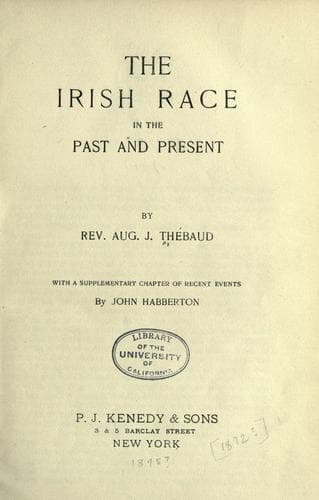
The Irish Race in the Past and the PresentThébaud, Augustus J.
History
The Irish Race in the Past and the Present
Thébaud, Augustus J.
Ireland -- History
Could any expression of ours set forth in stronger light the Celtic
mind and heart as portrayed in those native elements of music and
literature? Could any thing more forcibly depict the real character
of the race, materialized, as it were, in its exterior institutions?
We were right in saying that among no other race was what is
generally a mere adornment to a nation, raised to the dignity of
a social and political instrument as it was among the Celts. Hence
it was impossible for persecution and oppression to destroy it,
and the Celtic nature to-day is still traditional, full of faith,
and at the same time poetical and impulsive as when those great
features of the race held full sway.
Besides music, several other branches of art, particularly
architecture, design, and calligraphy, are worthy our attention,
presenting, as they do, features unseen anywhere else; and would
enable us still better to understand the character of the Celtic
race. But our limits require us to refrain from what might be
thought redundant and unnecessary.
We hasten, therefore, to consider another branch of our
investigation, one which might be esteemed paramount to all others,
and by the consideration of which we might have begun this chapter,
only that its importance will be better understood after what has
been already said. It is a chief characteristic which grew so
perfectly out of the Celtic mind and aptitudes, that long centuries
of most adverse circumstances, we may say, a whole host of contrary
influences were unable to make the Celts entirely abandon it. We
mean the clan system, which, as a system, indeed, has disappeared
these three centuries ago, but which may be said to subsist still
in the clan spirit, as ardent almost among them as ever.
It is beyond doubt that the patriarchal government was the first
established among men. The father ruled the family. As long as he
lived he was lawgiver, priest, master; his power was acknowledged
as absolute. Hiis children, even after their marriage, remained
to a certain extent subject to him. Yet each became in turn the
head of a small state, ruled with the primitive simplicity of
the first family.
In the East, history shows us that the patriarchal government
was succeeded immediately by an extensive and complete despotism.
Millions of men soon became the abject slaves of an irresponsible
monarch. Assyria, Babylonia, Egypt, appear at once in history as
powerful states at the mercy of a despot whose will was law.
Public-domain text, read in full here on John Shaqi.
Reviews
Reviews
No reviews yet
Be the first to share your thoughts on this work.
Join the Discussion
Join the discussion
Sign in to leave a comment or review.
Sign InorCreate an account