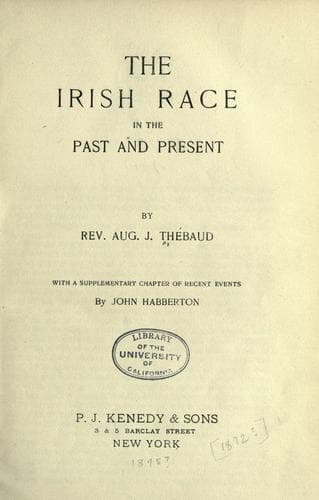
The Irish Race in the Past and the PresentThébaud, Augustus J.
History
The Irish Race in the Past and the Present
Thébaud, Augustus J.
Ireland -- History
Before Columba's time even the Church had become reconciled to
the bards and harpers; and, according to a beautiful legend,
Patrick himself had allowed Oisin, or Ossian, and his followers,
to sing the praises of ancient heroes. But Columbkill completed
the reconciliation of the religious spirit with the bardic
influence. Music and poetry were thenceforth identified with
ecclesiastical life. Monks and grave bishops played on the harp
in the churches, and it is said that this strange spectacle
surprised the first Norman invaders of Ireland. To use the words
of Montalembert, so well adapted to our subject: "Irish poetry,
which was in the days of Patrick and Columba so powerful and so
popular, has long undergone, in the country of Ossian, the same
fate as the religion of which these great saints were the apostles.
Rooted, like it, in the heart of a conquered people, and like it
proscribed and persecuted with an unwearying vehemence, it has
come ever forth anew from the bloody furrow in which it was
supposed to be buried. The bards became the most powerful allies
of patriotism, the most dauntless prophets of independence, and
also the favorite victims of the cruelty of spoilers and conquerors.
They made music and poetry weapons and bulwarks against foreign
oppression; and the oppressors used them as they had used the
priests and the nobles. A price was set upon their heads. But
while the last scions of the royal and noble races, decimated
or ruined in Ireland, departed to die out under a foreign sky,
amid the miseries of exile, the successor of the bards, the
minstrel, whom nothing could tear from his native soil, was pursued,
tracked, and taken like a wild beast, or chained and slaughtered
like the most dangerous of rebels.
"In the annals of the atrocious legislation, directed by the
English against the Irish people, as well before as after the
Reformation, special penalties against the minstrels, bards, and
rhymers, who sustained the lords and gentlemen, . . . are to be
met with at every step.
"Nevertheless, the harp has remained the emblem of Ireland, even
in the official arms of the British Empire, and during all last
century, the travelling harper, last and pitiful successor of the
bards, protected by Columba, was always to be found at the side of
the priest, to celebrate the holy mysteries of the proscribed worship.
He never ceased to be received with tender respect under the thatched
roof of the poor Irish peasant, whom he consoled in his misery and
oppression by the plaintive tenderness and solemn sweetness of the
music of his fathers."
Public-domain text, read in full here on John Shaqi.
Reviews
Reviews
No reviews yet
Be the first to share your thoughts on this work.
Join the Discussion
Join the discussion
Sign in to leave a comment or review.
Sign InorCreate an account