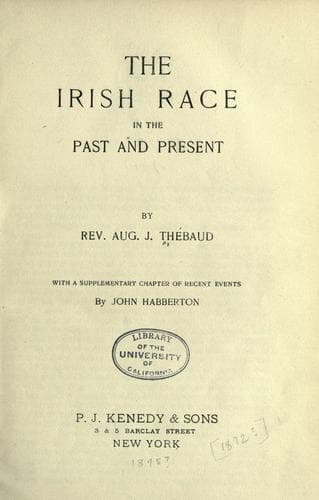
The Irish Race in the Past and the PresentThébaud, Augustus J.
History
The Irish Race in the Past and the Present
Thébaud, Augustus J.
Ireland -- History
It is true, when a surplus population compelled them to send abroad
swarms of their youth, that the conquest of a foreign country became
an absolute necessity. But, on such occasions it was outside of Celtic
limits that they spread themselves, taking possession of a territory
not their own. They almost invariably respected the land of other
clans of the same race, even when most hostile to them; exceptions
to this rule are extremely rare. It was thus that they sent large
armies of their young men into Northern Italy, along the Danube,
into Grecian Albania and Thrace, and finally into the very centre
of Asia Minor. The fixing of the geographical position of each tribe
was, therefore, a rule among them; and in this they differed from
nomadic nations, such as the Tartars in Asia and even the North
American Indians, whose hold on the land was too slight to offer any
prolonged resistance to invaders. Hence the position of the Gallic
_civitates_ was definite, and, so to speak, immovable, as we may see
by consulting the maps of ancient Gaul at any time anterior to its
thorough conquest by the Romans; not so among the German tribes,
whose positions on the maps must differ according to time.
We have already seen that so sacred were the limits of the clan
districts, that one of the chief duties of ollamhs and shanachies
was to know them and see them preserved.
But if territory was defined in Celtic nations, the right of
holding land differed in the case of the chieftain and the
clansman. The head of the tribe had a certain well-defined portion
assigned to him in virtue of his office, and as long only as he
held it; the clansmen held the remainder in common, no particular
spot being assigned to any one of them.
As far, therefore, as the holding of land was concerned, there
were neither rich nor poor among the Celts; the wealth of the
best of them consisted of cattle, house furniture, money, jewelry,
and other movable property. In the time of St. Columba, the
owner of five cows was thought to be a very poor man, although
he could send them to graze on any free land of his tribe. There
is no doubt that the almost insurmountable difficulty of the land
question at this time originated in the attachment of the people
to the old system, which had not yet perished in their affections;
and certainly many "agrarian outrages," as they are called, have
had their source in the traditions of a people once accustomed
to move and act freely in a free territory.
Public-domain text, read in full here on John Shaqi.
Reviews
Reviews
No reviews yet
Be the first to share your thoughts on this work.
Join the Discussion
Join the discussion
Sign in to leave a comment or review.
Sign InorCreate an account