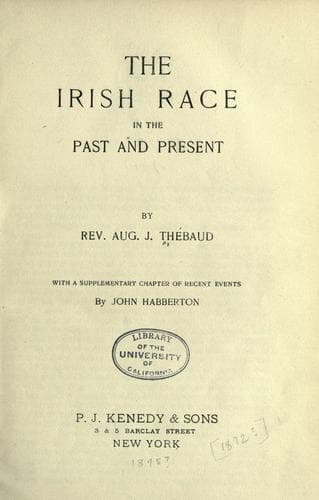
The Irish Race in the Past and the PresentThébaud, Augustus J.
History
The Irish Race in the Past and the Present
Thébaud, Augustus J.
Ireland -- History
It is needless to call the attention of the reader to another
consequence of that state of things, namely, the persistence of
territorial possessions. As no individual among them could alienate
his portion, no individual or family could absorb the territory to
the exclusion of others; no great landed aristocracy consequently
could exist, and no part of the land could pass by purchase or in
any other way to a different tribe or to an alien race. The force
of arms sometimes produced temporary changes, nothing more. It is
the same principle which has preserved the small Indian tribes
still existing in Canada. Their "reservations," as they are called,
having been legalized by the British Government at the time of
the conquest from the French, the territory assigned to them would
have remained in their occupancy forever in the midst of the
ever-shifting possessions of the white race, had not the Ottawa
Parliament lately "allowed" those reservations to be divided
among the families of the tribes, with power for each to dispose
of its portion, a power which will soon banish them from the
country of their ancestors.
The preceding observations do not conflict in the least with what
is generally said of inheritance by "gavel kind," whereby the
property was equally divided among the sons to the exclusion of
the daughters; as it is clear that the property to be thus divided
was only movable and personal property.
But after the _land_ we must consider the _persons_ under the
clan-system. Under this head we shall examine briefly:
I. The political offices, such as the dignities of Ard-Righ or
supreme monarch, of the provincial kings, and of the subordinate
chieftains.
II. The state of the common people.
III. The bondsmen or slaves.
All literary or civil offices, not political, were hereditary.
Hence the professions of ollamh, shanachy, bard, brehon, physician,
passed from father to son--a very injudicious arrangement apparently,
but it seems nevertheless to have worked well in Ireland. Strange
to say, however, these various classes formed no castes as in
Egypt or in India, because no one was prevented from embracing
those professions, even when not born to them; and, in the end,
success in study was the only requisite for reaching the highest
round of the literary or professional ladder, as in China.
But a stranger and more dangerous feature of the system was that
in political offices the dignities were hereditary as to the
family, elective as to the person. Hence the title of Ard-Righ
or supreme monarch did not necessarily pass to the eldest son of
the former king, but another member of the same family might be
elected to the office, and was even designated to it during the
lifetime of the actual holder, thus becoming _Tanist_ or heir-apparent.
Every one sees at a glance the numberless disadvantages resulting
from such an institution, and it must be said that most of the
bloody crimes recorded in Irish history sprang from it.
Public-domain text, read in full here on John Shaqi.
Reviews
Reviews
No reviews yet
Be the first to share your thoughts on this work.
Join the Discussion
Join the discussion
Sign in to leave a comment or review.
Sign InorCreate an account