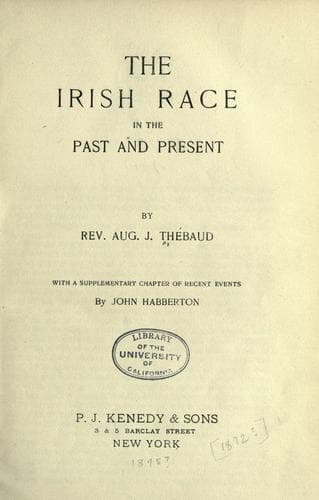
The Irish Race in the Past and the Present — John Shaqi
The Irish Race in the Past and the PresentThébaud, Augustus J.
History
The Irish Race in the Past and the Present
Thébaud, Augustus J.
Ireland -- History
It is true that, in reading the first chapters of all the various
histories of Ireland, the foreign reader is struck and almost
shocked by the dogmatism of the writers, who invariably, and with
a truly Irish assurance, begin with one of the sons of Japhet, and,
following the Hebrew or Septuagint chronology, describe without
flinching the various colonizations of Erin, not omitting the
synchronism of Assyrian, Persian, Greek, and Roman history. A
smile is at first the natural consequence of such assertions; and,
indeed, there is no obligation whatever to believe that every thing
happened exactly as they relate.
But when the large quartos and octavos which are now published from
time to time by the students of Irish antiquarian lore are opened,
read, and pondered over, at least one consequence is drawn from
them which strikes the reader with astonishment. "There can be no
doubt," every candid mind says to itself, "that this nation has
preceded in time all those which have flourished on the earth, with
the exception, perhaps, of the Chinese, and that it remains the same
to-day." At least, many years before Christ, a race of men inhabited
Ireland exactly identical with its present population (except that
it did not enjoy the light of the true religion), yet very superior
to it in point of material well-being. Not a race of cannibals, as
the credulous Diodorus Siculus, on the strength of some vague
tradition, was pleased to delineate; but a people acquainted with
the use of the precious metals, with the manufacture of fine tissues,
fond of music and of song, enjoying its literature and its books;
often disturbed, it is true, by feuds and contentions, but, on the
whole, living happily under the patriarchal rule of the clan system.
The ruins which are now explored, the relics of antiquity which
are often exhumed, the very implements and utensils preserved by
the careful hand of the antiquarian--every thing, so different
from the rude flint arrows and barbarous weapons of our North
American Indians and of the European savages of the Stone period,
denotes a state of civilization, astonishing indeed, when we reflect
that real objects of art embellished the dwellings of Irishmen
probably before the foundation of Rome, and perhaps when Greece
was as yet in a state of heroic barbarism.
Public-domain text, read in full here on John Shaqi.
Reviews
Reviews
No reviews yet
Be the first to share your thoughts on this work.
Join the Discussion
Join the discussion
Sign in to leave a comment or review.
Sign InorCreate an account