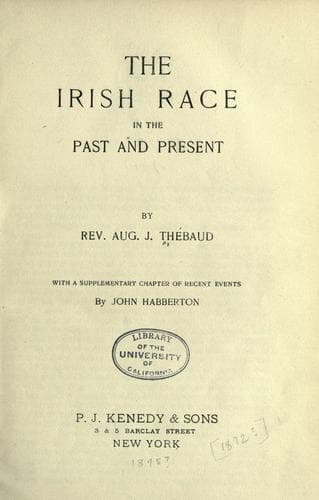
The Irish Race in the Past and the PresentThébaud, Augustus J.
History
The Irish Race in the Past and the Present
Thébaud, Augustus J.
Ireland -- History
And this high antiquity is proved by literature as well as by art.
"The ancient Irish," says one of their latest historians, M.
Haverty, "attributed the utmost importance to the accuracy of their
Historic compositions for social reasons. Their whole system of
society--every question as to right of property--turned upon the
descent of families and the principle of clanship; so that it cannot
be supposed that mere fables would be tolerated instead of facts,
where every social claim was to be decided on their authority. A
man's name is scarcely mentioned in our annals without the addition
of his forefathers for several generations--a thing which rarely
occurs in those of other countries.
"Again, when we arrive at the era of Christianity in Ireland, we
find that our ancient annals stand the test of verification by
science with a success which not only establishes their character
for truthfulness at that period, but vindicates the records of
preceding dates involved in it."
The most confirmed skeptic cannot refuse to believe that at the
introduction of Christianity into Ireland, in 432, the whole island
was governed by institutions exactly similar to those of Gaul when
Julius Caesar entered it 400 years before; that this state must
have existed for a long time anterior to that date; and that the
reception of the new religion, with all the circumstances which
attended it, introduced the nation at once into a happy and social
state, which other European countries, at that time convulsed by
barbarian invasions, did not attain till several centuries later.
These various considerations would alone suffice to show the real
importance of the study we undertake; but a much more powerful
incentive to it exists in the very nature of the annals of the
nation itself.
Ireland is a country which, during the last thousand years, has
maintained a constant struggle against three powerful enemies,
and has finally conquered them all.
The first stage of the conflict was that against the Northmen.
It lasted three centuries, and ended in the almost complete
disappearance of this foe.
The second act of the great drama occupied a period of four Hundred
years, during which all the resources of the Irish clans were arrayed
against Anglo-Norman feudalism, which had finally to succumb; so
that Erin remained the only spot in Europe where feudal institutions
never prevailed.
The last part of this fearful trilogy was a conflict of three centuries
with Protestantism; and the final victory is no longer doubtful.
Can any other modern people offer to the meditation, and, we must
say, to the admiration of the Christian reader, a more interesting
spectacle? The only European nation which can almost compete with
the constancy and never-dying energy of Ireland is the Spanish in
its struggle of seven centuries with the Moors.
Public-domain text, read in full here on John Shaqi.
Reviews
Reviews
No reviews yet
Be the first to share your thoughts on this work.
Join the Discussion
Join the discussion
Sign in to leave a comment or review.
Sign InorCreate an account