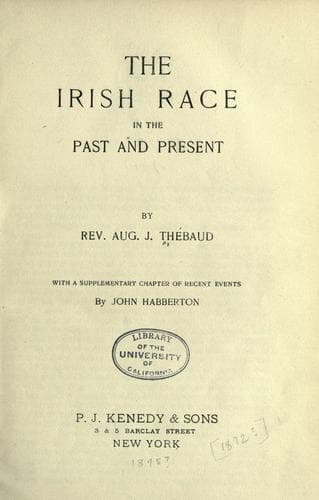
The Irish Race in the Past and the PresentThébaud, Augustus J.
History
The Irish Race in the Past and the Present
Thébaud, Augustus J.
Ireland -- History
It was in the midst of those worldly glories that Christ was
born, that he preached, and suffered, that his religion was
established and propagated. It found proselytes at once among
the most polished and the most learned of men, as well as among
slaves and artisans; and thus was it proved that Christianity
could satisfy the loftiest aspirations of the most civilized as
well as insure the happiness of the most numerous and miserable
classes.
But we must reflect that the advanced civilization of Greece and
Rome was in fact an immense obstacle to the propagation of truth,
and, what is more to be regretted, often gave an unnatural
aspect to the Christianity of the first ages in the Roman world--
a half-pagan look--so that the barbarian invasion was almost
necessary to destroy every thing of the natural order; that the
Church alone remaining face to face with those uncouth children
of the North, might begin her mission anew and mould them all
into the family called "Christendom." "Christianity," to
quote Ozanam again, "shrank from condemning a veneration of the
beautiful, although idolatry was contained in it; and as it
honored the human mind and the arts it produced, so the
persecution of the apostate Julian, in which the study of the
classics had been forbidden to the faithful, was the severest of
its trials. Literary history possesses no moment of greater
interest than that which saw the school with its profane
--that is to say pagan--traditions and texts received into the
Church. The Fathers, whose christian austerity is our wonder,
were passionate in their love of antiquity, which they covered,
as it were, with their sacred vestments. . . . By their favor,
Virgil traversed the ages of iron without losing a page, and, by
right of his Fourth Eclogue, took rank among the prophets and
the sibyls. St. Augustine would have blamed paganism less, if,
in place of a temple to Cybele, it had raised a shrine to Plato,
in which his works might have been publicly read. St. Jerome's
dream is well known, and the scourging inflicted upon him by
angels for having loved Cicero too well; yet his repentance was
but short-lived, since he caused the monks of the Mount of
Olives to pass their nights in copying the Ciceronian dialogues,
and did not shrink himself from expounding the comic and lyric
poets to the children of Bethlehem."
We know already that nothing of the kind existed in Ireland when
the Gospel reached her, and that there the new religion assumed
a peculiar aspect, which has never varied, and which made her at
once and forever a preeminently Christian nation.
Among the Greeks and Romans, literature and art, although
accepted by the Church, were nevertheless deeply impregnated
with paganism. All their chief acts of social life required a
profession of idolatry; even amusements, dramatic
representations, and simple games, were religious and
consequently pagan exhibitions.
Public-domain text, read in full here on John Shaqi.
Reviews
Reviews
No reviews yet
Be the first to share your thoughts on this work.
Elsewhere in the archive
Join the Discussion
Join the discussion
Sign in to leave a comment or review.
Sign InorCreate an account