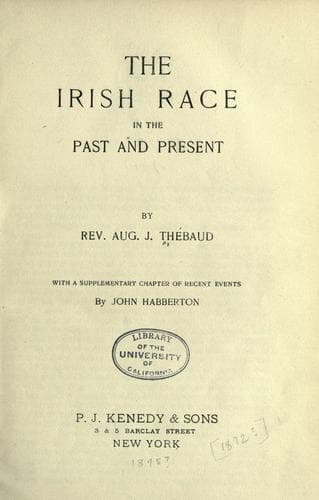
The Irish Race in the Past and the PresentThébaud, Augustus J.
History
The Irish Race in the Past and the Present
Thébaud, Augustus J.
Ireland -- History
We do not here speak of the attractions of an atheistic and
materialist philosophy, of a voluptuous, often, and demoralizing
literature and poetry, of an unimaginable prostitution of art to
the vilest passions, which the relics of Pompeii too abundantly
indicate.
But apart from those excesses of corruption and unbelief, which,
no doubt, virtuous pagans themselves abhorred, the approved,
correct, and so-called pure life of the best men of pagan Rome
necessitated the contamination of idolatrous worship. Apart from
the thousand duties, festivals, and the like, decreed or
sanctioned by the state, the most ordinary acts of life, the
enlisting of the soldier, the starting on a military expedition,
the assumption of any civil office or magistracy, the civil
oaths in the courts of law, the public bath, the public walk
almost, the current terms in conversation, the private reading
of the best books, the mere glancing at a multitude of exterior
objects, constituted almost as many professions of a false and
pagan worship.
How could any one become a Christian and at the same time remain
a Greek or a Roman? The gloomy views of the Montanist Tertullian
were, to many, frightful truths requiring constant care and self-
examen. For the Christian there were two courses open--both
excesses, yet either almost unavoidable: on the one side, a
terrible rigorism, making life unsupportable, next to impossible;
on the other, a laxity of thought and action leading to
lukewarmness and sometimes apostasy.
Bearing in mind what was written on the subject in the first
three ages of Christianity, not only by Tertullian, but by most
orthodox writers, St. Cyprian, Lactantius, Arnobius, and the
authors of many Acts of martyrs, we may easily understand how
the doctrines of Christianity stood in danger of never taking
deep root in the hearts of men surrounded by such temptations,
themselves born in paganism, and remaining, after their
conversion, exposed to seductions of such an alluring character.
Therefore this same "high civilization," as it is called, in the
midst of which Christianity was preached, was a real danger to
the inward life of the new disciple of Christ.
How could it be otherwise, when it is a fact now known to
all, that, even at the beginning of the fifth century, Rome was
almost entirely pagan, at least outwardly, and among her highest
classes; so that the poet Claudian, in addressing Honorius at the
beginning of his sixth consulship, pointed out to him the site of
the capitol still crowned with the Temple of Jove, surrounded by
numerous pagan edifices, supporting in air an army of gods; and
all around temples, chapels, statues, without number--in fact, the
whole Roman and Greek mythology, standing in the City of the
Catacombs and of the Popes!
Public-domain text, read in full here on John Shaqi.
Reviews
Reviews
No reviews yet
Be the first to share your thoughts on this work.
Elsewhere in the archive
Join the Discussion
Join the discussion
Sign in to leave a comment or review.
Sign InorCreate an account