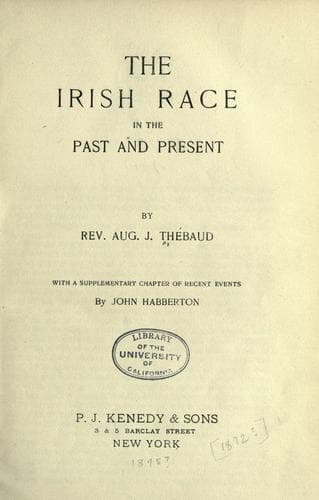
The Irish Race in the Past and the PresentThébaud, Augustus J.
History
The Irish Race in the Past and the Present
Thébaud, Augustus J.
Ireland -- History
The public calendars, preserved to this day, continued to note
the pagan festivals side by side with the feasts of the Saviour
and his apostles. Within the city and beyond, throughout Italy
and the most remote provinces, idols and their altars were still
surrounded by the thronging populace, prostrate at their feet.
If in the cities the new religion already dared display
something of its inherent splendor, the whole rural population
was still pagan, singing the praises of Ceres and of Bacchus,
trembling at Fauns and Satyrs and the numerous divinities of the
groves and fountains. Christianity then held the same standing
in Italy that in the United States Catholicity holds to-day in
the midst of innumerable religious sects.
This is not the place to show how far the paganism of Greece and
Rome had corrupted society, and how complete was its rottenness
at the time. It has been already shown by several great writers
of this century. Enough for our purpose to remark that even some
Christian writers, of the age immediately succeeding that of the
early martyrs, showed themselves more than half pagans in their
tastes and productions. Ausonius in the West, the preceptor of
St. Paulinus, is so obscene in some of his poems, so thoroughly
pagan in others, that critics have for a long time hesitated to
pronounce him a Christian. How many of his contemporaries
hovered like him on the confines of Christianity and paganism!
When Julian the apostate restored idolatry, many, who had only
disgraced the name of Christian, openly returned to the worship
of Jupiter and Venus, and their apostasy could scarcely be cause
for regret to sincere disciples of our Lord.
In the East the phenomenon is less striking. Strange to say,
idolatry did not remain so firmly rooted in the country, where
it first took such an alluring shape; and Constantinople was in
every sense of the word a Christian city when Rome, in her
senate, fought with such persistent tenacity for her altars of
Victory, her vestals, and her ancient worship.
Yet there, also, Christian writers were too apt to interfuse the
old ideas with the new, and to adopt doctrines placed, as it
were, midway between those of Plato and St. Paul. There were
bishops even who were a scandal to the Church and yet remained
in it. Synesius is the most striking example; whose doctrine was
certainly more philosophical than Christian, and whose life,
though decorous, was altogether worldly. The history of Arianism
shows that others besides Synesius were far removed from the
ideal of Christian bishops so worthily represented at the time
by many great doctors and holy pontiffs.
Such, in the East as well as in the West, were the perils
besetting the true Christian spirit at the very cradle of our
holy religion.
Public-domain text, read in full here on John Shaqi.
Reviews
Reviews
No reviews yet
Be the first to share your thoughts on this work.
Elsewhere in the archive
Join the Discussion
Join the discussion
Sign in to leave a comment or review.
Sign InorCreate an account