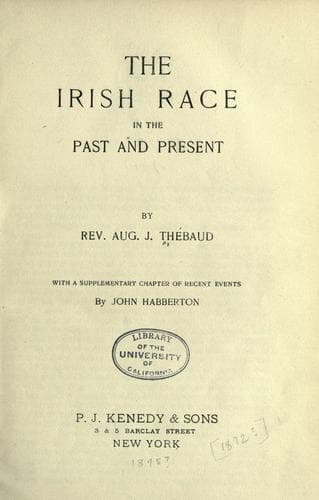
The Irish Race in the Past and the PresentThébaud, Augustus J.
History
The Irish Race in the Past and the Present
Thébaud, Augustus J.
Ireland -- History
Nor was the danger confined to the mythology of paganism, its
literature and poetry. Philosophy itself became a real stumbling-
block to many, who would fain appear disciples of faith, when
they gave themselves up to the most unrestrained wanderings of
human reason.
The truth is, that Greek philosophy, divided into so many
schools in order to please all tastes, had become a wide-spread
institution throughout the Roman world. The mind of the East was
best adapted to it, and those who taught it were, consequently,
nearly all Greeks. Cicero had made it fashionable among many of
his countrymen; and although the Latin mind, always practical to
the verge of utilitarianism, was not congenial to utopian
speculations, still, as it was the fashion, all intellectual men
felt the need of becoming sufficiently acquainted with it to be
able to speak of it and even to embrace some particular school.
Those patricians, who remained attached to the stern principles
of the old republic, became Stoics; while the men of the corrupt
aristocracy called themselves, with Horace, members of the
"Epicurean herd." Hence the necessity for all to train their
minds to scientific speculation, converted the Western world
into a hot-bed of wild and dangerous doctrines.
In the opinion of some Eastern Fathers of the Church, Greek
philosophy had been a preparation for the Gospel, and could be
made subservient to the conversion of many. Thus we find St.
Justin, the martyr, all his life long glorying in the name of
philosopher, and continuing to wear, even after his conversion,
the philosopher's cloak so much derided by the scoffer, Lucian.
Still, despite this very respectable opinion, we can entertain
no doubt, in view of what happened at the time and of subsequent
events, that philosophy grew to be a stumbling-block in the path
of Christianity, and originated the worst and most dangerous
forms of heresy; that it sowed the seed, in the European mind,
of all errors, by creating that speculative tendency of
character so peculiar to most branches of the Japhetic race.
Persian Dualism, and, as many think, Pantheistic Buddhism, which
were then flourishing in Central and Eastern Asia, infected the
Alexandrian schools, and impressed philosophy with a new and
dreamy character, which became the source of subsequent and
frightful errors. The Neo-Platonism of Porphyry and Plotinus was
intended, in the minds of its originators, to lay a scientific
basis for polytheism; and, in Jamblichus finally, became an open
justification of the most absurd fables of mythology.
Public-domain text, read in full here on John Shaqi.
Reviews
Reviews
No reviews yet
Be the first to share your thoughts on this work.
Elsewhere in the archive
Join the Discussion
Join the discussion
Sign in to leave a comment or review.
Sign InorCreate an account