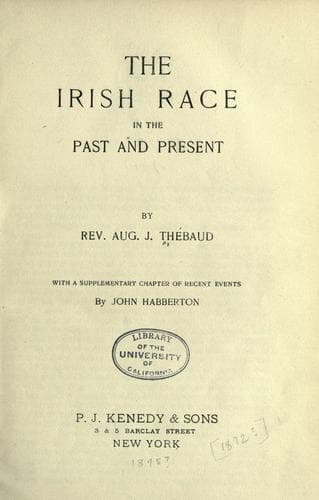
The Irish Race in the Past and the Present — John Shaqi
The Irish Race in the Past and the PresentThébaud, Augustus J.
History
The Irish Race in the Past and the Present
Thébaud, Augustus J.
Ireland -- History
We have thought, therefore, that there might be some real interest
and profit to be derived from the study of this eventful national
life--an interest and a profit which will appear as we study it
more in detail.
It may be said that the threefold conflict which we have outlined
might be condensed into the surprising fact that all efforts to
drag Ireland into the current of European affairs and influence
have invariably failed. This is the key to the understanding of
her whole history.
Even originally, when it formed but a small portion of the great
Celtic race, here existed in the Irish branch a peculiarity of its
own, which stamped it with features easy to be distinguished. The
gross idolatry of the Gauls never prevailed among the Irish; the
Bardic system was more fully developed among them than among any
other Celtic nation. Song, festivity, humor, ruled there much more
universally than elsewhere. There were among them more harpers and
poets than even genealogists and antiquarians, although the branches
of study represented by these last were certainly as well cultivated
among them as among the Celts of Gaul, Spain, or Italy.
But it is chiefly after the introduction of Christianity among
them, when it appeared finally decreed that they should belong
morally and socially to Europe, it is chiefly then that their
purpose, however unconscious they may have been of its tendency,
seems more defined of opening up for themselves a path of their
own. And in this they followed only the promptings of Nature.
The only people in Europe which remained untouched by what is
called Roman civilization--never having seen a Roman soldier on
their shores; never having been blessed by the construction of
Roman baths and amphitheatres; never having listened to the
declamations of Roman rhetoricians and sophists, nor received the
decrees of Roman praetors, nor been subject to the exactions of
the Roman fisc--they never saw among them, in halls and basilicas
erected under the direction of Roman architects, Roman judges,
governors, proconsuls, enforcing the decrees of the Caesars
against the introduction or propagation of the Christian religion.
Hence it entered in to them without opposition and bloodshed.
But the new religion, far from depriving them of their characteristics,
consecrated and made them lasting. They had their primitive traditions
and tastes, their patriarchal government and manners, their ideas of
true freedom and honor, reaching back almost to the cradle of mankind.
They resolved to hold these against all comers, and they have been
faithful to their resolve down to our own times. Fourteen hundred years
of history since Patrick preached to them proves it clearly enough.
Public-domain text, read in full here on John Shaqi.
Reviews
Reviews
No reviews yet
Be the first to share your thoughts on this work.
Join the Discussion
Join the discussion
Sign in to leave a comment or review.
Sign InorCreate an account