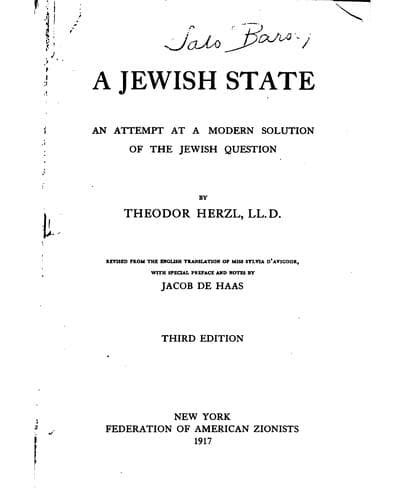
Herzl, Theodor, 1860-1904; Zionism; Zionists -- Austria -- Biography
The beginnings of the Jewish renaissance preceded the appearance of
"The Jewish State" by several decades. In every section of Russian
Jewry and extending to wherever the Jews clung to their Hebraic
heritage, there was an active Zionist life. The reborn Hebrew was
becoming an all-pervading influence. There were scores of Hebrew
schools and academies. Hebrew journals of superior quality had a wide
circulation. Ever since the pogroms of 1881, the ideas of Pinsker and
Smolenskin and Gordon were discussed with great interest and deep
understanding. There were many Zionist societies in Russia, in Poland,
in Rumania, in Galicia and even in the United States. In "The Jewish
State" Herzl alludes to the language of The Jewish State and passes
Hebrew by as a manifestation of no great significance. He has a poorer
opinion of Yiddish, the common language of Jews, which he regards as
"the furtive language of prisoners." This was obviously an oversight.
With the advent of Herzl, however, Zionism was no more a matter of
domestic concern only. It was no longer internal Jewish problem only,
not a theme for discussion only at Zionist meetings, not a problem to
heat the spirits of Jewish writers. The problem of Jewish exile now
occupied a place on the agenda of international affairs.
* * * * *
Herzl was not so distant from his people as many of the Russian
Zionists at first surmised. He was familiar with the social
anti-Semitism of Austria and Germany. He knew of the disabilities of
the Jews in Russia. There are many references in his feuilletons to
matters of Jewish interest. He had read an anti-Semitic book written
by Eugen Duehring called "The Jewish Problem as a Problem of Race,
Morals and Culture." One of his closest friends had gone to Brazil for
a Jewish committee to investigate the possibility of settling Jews in
that part of South America. In 1892 he wrote an article on French
anti-Semitism in which he considered the solution of a return to Zion
and seemed to reject it. He wrote "The New Ghetto" two years before
"The Jewish State" appeared. He was present at the trial of Alfred
Dreyfus in December, 1894. He witnessed the degradation of Dreyfus and
heard the cries of "Down with the Jews" in the streets of Paris. He
read Edouard Drumont's anti-Semitic journal "La France Juive" and
said, "I have to thank Drumont for much of the freedom of my present
conception of the Jewish problem." While he was in Paris he was
stirred as never before by the feeling that the plight of the Jews was
a problem which would have to have the cooperation of enlightened
statesmanship. What excited him in the strangest way was the
unaccountable indifference of Jews themselves to what seemed to him
the menace of the existing situation. He saw the Jews in every land
encircled by enemies, hostility to them growing with the increase of
their numbers. In his excitement he thought first of Jewish
philanthropists.
Public-domain text, read in full here on John Shaqi.
Reviews
Reviews
No reviews yet
Be the first to share your thoughts on this work.
Join the Discussion
Join the discussion
Sign in to leave a comment or review.
Sign InorCreate an account