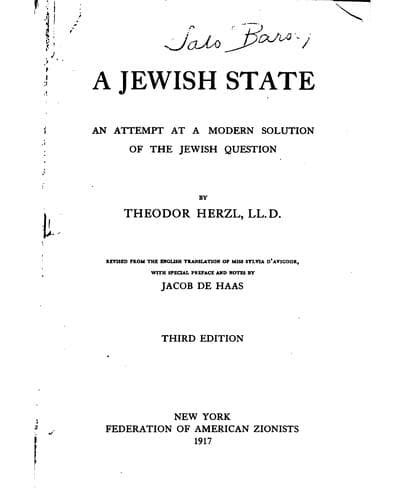
Herzl, Theodor, 1860-1904; Zionism; Zionists -- Austria -- Biography
He sought an interview with Baron Maurice de Hirsch
in May, 1895. He planned an address to the Rothschilds. He talked of
his ideas to friends in literary circles. His mind was obsessed by a
gigantic problem which gave him no rest. He was struggling to pierce
the veils of revelation. He saw a world in which the Jewish people
lacked a fulcrum for national action and therefore had to seek to
create it through beneficence. He had a remarkably resourceful and
agile imagination. He weighed ideas, balanced them, discarded them,
reflected, reconsidered, tried to reconcile contradictions, and
finally came to what seemed to him at the moment the synthesis of the
issue which seemed acceptable to reason and sentiment.
* * * * *
Obviously, "The Jewish State" was not a dogmatic finality. Most of the
plans for settlement and migration are improvisations. The pamphlet
was not a rigid plan or a blueprint. It was not a description of a
Utopia, although some parts of it give that impression. It had an
indicated destiny but was not bound by a rigid line. It was the
illumination of a dynamic thought and followed the light with the hope
that it might lead to fulfillment. There was room for detours and
variations. It was to be rewritten, as he knew, not by its author but
by the Jewish people on their way to freedom.
* * * * *
In fact, it was revised from the moment the Zionist movement was
organized on an international basis. The "Society of Jews" became the
Zionist Organization, with its statutes, its procedures, its public
excitement and controversies. "The Jewish Company" became the Bank;
then more specifically, the Jewish Colonial Trust and later the
Anglo-Palestine Bank. The description of the _Gestor_, which appears
in the final chapter of the pamphlet, was never referred to again,
but in effect it was incorporated in the idea of a state
in-the-process-of-becoming. Its legitimate successor is the Jewish
Agency referred to in the Mandate for Palestine. He was first led by
the idea that the way to the charter was through the Sultan and that
the Sultan would be influenced by Kaiser Wilhelm. But both princes
failing him, he turned to England and Joseph Chamberlain, and came to
the Uganda proposal. This was Herzl's one political success although
the project was, in effect, rejected by the Zionist Congress. But
this encounter with England was a precedent which led to much
speculation in Zionist circles and gave a turn to Zionist thought
away from Germany and Turkey. It served to inspire Dr. Chaim Weizman
to make his home in England with the express purpose of seeking
English sympathy for the Zionist ideal. The successor of Joseph
Chamberlain was Arthur James Balfour. When Herzl opened Chamberlain's
door, Zionism had an easier access to the England of Balfour.
Public-domain text, read in full here on John Shaqi.
Reviews
Reviews
No reviews yet
Be the first to share your thoughts on this work.
Join the Discussion
Join the discussion
Sign in to leave a comment or review.
Sign InorCreate an account