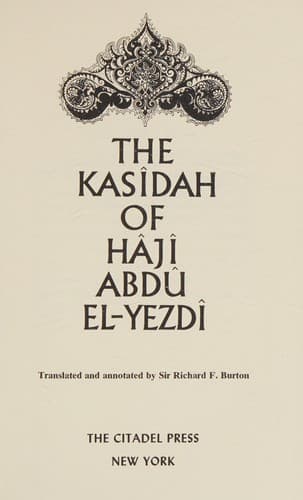
The Kasîdah of Hâjî Abdû El-YezdîBurton, Richard Francis, Sir
Philosophy
The Kasîdah of Hâjî Abdû El-Yezdî
Burton, Richard Francis, Sir
English poetry -- 19th century
Haply the Law that rules the world
allows to man the widest range;
And haply Fates a Theist-word,
subject to human chance and change.
This I may find a future Life,
a nobler copy of our own,
Where every riddle shall be reed,
where every knowledge shall be known;
Where twill be mans to see the whole
of what on Earth he sees in part;
Where change shall neer surcharge the thought;
nor hope deferd shall hurt the heart.
But!faded flower and fallen leaf
no more shall deck the parent tree;
And man once dropt by Tree of Life
what hope of other life has he?
The shatterd bowl shall know repair;
the riven lute shall sound once more;
But who shall mend the clay of man,
the stolen breath to man restore?
The shiverd clock again shall strike;
the broken reed shall pipe again:
But we, we die, and Death is one,
the doom of brutes, the doom of men.
Then, if Nirwânâ* round our life
with nothingness, tis haply best;
Thy toils and troubles, want and woe
at length have won their guerdonRest.
* Comparative annihilation.
Cease, Abdû, cease! Thy song is sung,
nor think the gain the singers prize;
Till men hold Ignorance deadly sin,
till man deserves his title Wise:*
* Homo sapiens.
In Days to come, Days slow to dawn,
when Wisdom deigns to dwell with men,
These echoes of a voice long stilled
haply shall wake responsive strain:
Wend now thy way with brow serene,
fear not thy humble tale to tell:
The whispers of the Desert-wind;
the tinkling of the camels bell.
{Hebrew: ShLM}
NOTES
NOTE I
HÂJÎ ABDÛ, THE MAN
Hâjî Abdû has been known to me for more years than I care to
record. A native, it is believed, of Darâbghird in the Yezd
Province, he always preferred to style himself El-Hichmakâni, a
facetious lackab or surname, meaning Of No-hall, Nowhere. He
had travelled far and wide with his eyes open; as appears by his
couplets. To a natural facility, a knack of language learning,
he added a store of desultory various reading; scraps of Chinese
and old Egyptian; of Hebrew and Syriac; of Sanskrit and Prakrit;
of Slav, especially Lithuanian; of Latin and Greek, including
Romaic; of Berber, the Nubian dialect, and of Zend and Akkadian,
besides Persian, his mother-tongue, and Arabic, the classic of
the schools. Nor was he ignorant of the -ologies and the
triumphs of modern scientific discovery. Briefly, his memory was
well-stored; and he had every talent save that of using his
talents.
But no one thought that he wood the Muse, to speak in the
style of the last century. Even his intimates were ignorant of
the fact that he had a skeleton in his cupboard, his Kasîdah or
distichs. He confided to me his secret when we last met in
Western IndiaI am purposely vague in specifying the place. When
so doing he held in hand the long and hoary honours of his chin
with the points toward me, as if to say with the Island-King:
Public-domain text, read in full here on John Shaqi.
Reviews
Reviews
No reviews yet
Be the first to share your thoughts on this work.
Join the Discussion
Join the discussion
Sign in to leave a comment or review.
Sign InorCreate an account