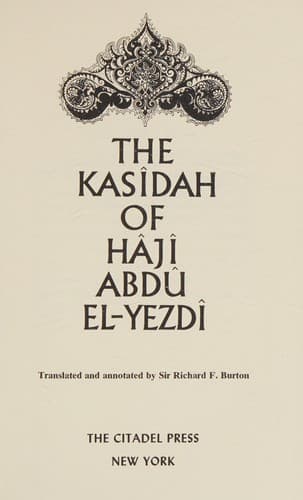
The Kasîdah of Hâjî Abdû El-YezdîBurton, Richard Francis, Sir
Philosophy
The Kasîdah of Hâjî Abdû El-Yezdî
Burton, Richard Francis, Sir
English poetry -- 19th century
There is a touch of Winter in my beard,
A sign the Gods will guard me from imprudence.
And yet the piercing eye, clear as an onyx, seemed to protest
against the plea of age. The MS. was in the vilest Shikastah or
running-hand; and, as I carried it off, the writer declined to
take the trouble of copying out his cacograph.
We, his old friends, had long addressed Hâjî Abdû by the
sobriquet of _Nabbianâ_ (our Prophet); and the reader will see
that the Pilgrim has, or believes he has, a message to deliver.
He evidently aspires to preach a faith of his own; an Eastern
Version of Humanitarianism blended with the sceptical or, as we
now say, the scientific habit of mind. The religion, of which
Fetishism, Hinduism and Heathendom; Judæism, Christianity and
Islamism are mere fractions, may, methinks, be accepted by the
Philosopher: it worships with single-minded devotion the Holy
Cause of Truth, of Truth for its own sake, not for the goods it
may bring; and this belief is equally acceptable to honest
ignorance, and to the highest attainments in nature-study.
With Confucius, the Hâjî cultivates what Strauss has called the
stern common-sense of mankind; while the reign of order is a
paragraph of his Higher Law. He traces from its rudest
beginnings the all but absolute universality of some perception
by man, called Faith; that _sensus Numinis_ which, by
inheritance or communication, is now universal except in those
who force themselves to oppose it. And he evidently holds this
general consent of mankind to be so far divine that it primarily
discovered for itself, if it did not create, a divinity. He does
not cry with the Christ of Novalis, Children, you have no
father; and perhaps he would join Renan in exclaiming, _Un monde
sans Dieu est horrible!_
But he recognises the incompatibility of the Infinite with the
Definite; of a Being who loves, who thinks, who hates; of an
_Actus purus_ who is called jealous, wrathful and revengeful,
with an Eternal that makes for righteousness. In the presence
of the endless contradictions, which spring from the idea of a
Personal Deity, with the Synthesis, the _Begriff_ of Providence,
our Agnostic takes refuge in the sentiment of an unknown and an
unknowable. He objects to the countless variety of forms assumed
by the perception of a _Causa Causans_ (a misnomer), and to that
intellectual adoption of general propositions, capable of
distinct statement but incapable of proofs, which we term Belief.
Public-domain text, read in full here on John Shaqi.
Reviews
Reviews
No reviews yet
Be the first to share your thoughts on this work.
Join the Discussion
Join the discussion
Sign in to leave a comment or review.
Sign InorCreate an account