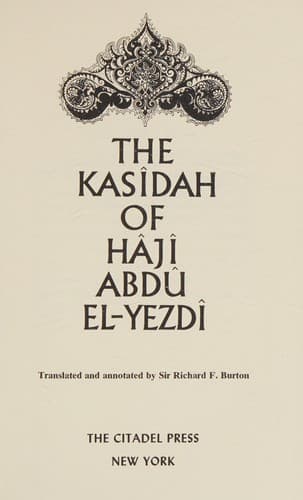
The Kasîdah of Hâjî Abdû El-YezdîBurton, Richard Francis, Sir
Philosophy
The Kasîdah of Hâjî Abdû El-Yezdî
Burton, Richard Francis, Sir
English poetry -- 19th century
Christianity and Islamism have been on their trial for the last
eighteen and twelve centuries. They have been ardent in
proselytizing, yet they embrace only one-tenth and one-twentieth
of the human race. Hâjî Abdû would account for the tardy and
unsatisfactory progress of what their votaries call pure
truths, by the innate imperfections of the same. Both propose a
reward for mere belief, and a penalty for simple unbelief;
rewards and punishments being, by the way, very disproportionate.
Thus they reduce everything to the scale of a somewhat unrefined
egotism; and their demoralizing effects become clearer to every
progressive age.
Hâjî Abdû seeks Truth only, truth as far as man, in the present
phase of his development, is able to comprehend it. He disdains
to associate utility, like Bacon (Nov. Org. I. Aph. 124), the
High Priest of the English Creed, _le gros bon sens_, with the
_lumen siccum ac purum notionum verarum_. He seems to see the
injury inflicted upon the sum of thought by the _â posteriori_
superstition, the worship of facts, and the deification of
synthesis. Lastly, came the reckless way in which Locke freed
philosophy from the incubus of innate ideas. Like Luther and the
leaders of the great French Revolution, he broke with the Past;
and he threw overboard the whole cargo of human tradition. The
result has been an immense movement of the mind which we love to
call Progress, when it has often been retrograde; together with a
mighty development of egotism resulting from the pampered
sentiment of personality.
The Hâjî regrets the excessive importance attached to a possible
future state: he looks upon this as a psychical stimulant, a day
dream, whose revulsion and reaction disorder waking life. The
condition may appear humble and prosaic to those exalted by the
fumes of Fancy, by a spiritual dram-drinking, which, like the
physical, is the pursuit of an ideal happiness. But he is too
wise to affirm or to deny the existence of another world. For
life beyond the grave there is no consensus of mankind, no
Catholic opinion held _semper, et ubique, et ab omnibus_. The
intellectual faculties (perception and reflection) are mute upon
the subject: they bear no testimony to facts; they show no proof.
Even the instinctive sense of our kind is here dumb. We may
believe what we are taught: we can know nothing. He would,
therefore, cultivate that receptive mood which, marching under
the shadow of mighty events, leads to the highest of goals,the
development of Humanity. With him suspension of judgment is a
system.
Public-domain text, read in full here on John Shaqi.
Reviews
Reviews
No reviews yet
Be the first to share your thoughts on this work.
Join the Discussion
Join the discussion
Sign in to leave a comment or review.
Sign InorCreate an account