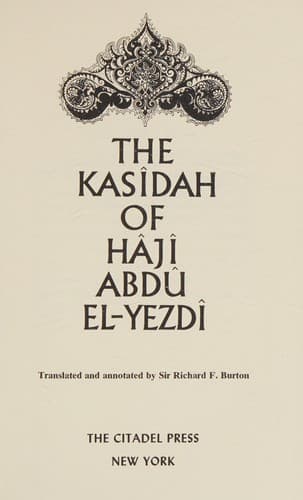
The Kasîdah of Hâjî Abdû El-YezdîBurton, Richard Francis, Sir
Philosophy
The Kasîdah of Hâjî Abdû El-Yezdî
Burton, Richard Francis, Sir
English poetry -- 19th century
Man has done much during the sixty-eight centuries which
represent his history. This assumes the first Egyptian Empire,
following the pre-historic, to begin with B. C. 5000, and to end
with B. C. 3249. It was the Old, as opposed to the Middle, the
New, and the Low: it contained the Dynasties from I. to X., and
it was the age of the Pyramids, at once simple, solid, and grand.
When the praiser of the Past contends that modern civilization
has improved in nothing upon Homer and Herodotus, he is apt to
forget that every schoolboy is a miracle of learning compared
with the Cave-man and the palæolithic race. And, as the Past has
been, so shall the Future be.
The Pilgrims view of life is that of the Soofi, with the usual
dash of Buddhistic pessimism. The profound sorrow of existence,
so often sung by the dreamy Eastern poet, has now passed into the
practical European mind. Even the light Frenchman murmurs,
Moi, moi, chaque jour courbant plus bas ma tête
Je passeet refroidi sous ce soleil joyeux,
Je men irai bientôt, au milieu de la fête,
Sans que rien manque au monde immense et radieux.
But our Hâjî is not Nihilistic in the no-nothing sense of
Hoods poem, or, as the American phrases it, There is nothing
new, nothing true, and it dont signify. His is a healthy wail
over the shortness, and the miseries of life, because he finds
all created things
Measure the world, with Me immense.
He reminds us of St. Augustine (Med. c. 21). Vita hæc, vita
misera, vita caduca, vita incerta, vita laboriosa, vita immunda,
vita domina malorum, regina superborum, plena miseriis et
erroribus . . . Quam humores tumidant, escæ inflant, jejunia
macerant, joci dissolvunt, tristitiæ consumunt; sollicitudo
coarctat, securitas hebetat, divitiæ inflant et jactant.
Paupertas dejicit, juventus extollit, senectus incurvat,
importunitas frangit, mæror deprimit. Et his malis omnibus mors
furibunda succedit. But for _furibunda_ the Pilgrim would
perhaps read _benedicta_.
Public-domain text, read in full here on John Shaqi.
Reviews
Reviews
No reviews yet
Be the first to share your thoughts on this work.
Join the Discussion
Join the discussion
Sign in to leave a comment or review.
Sign InorCreate an account