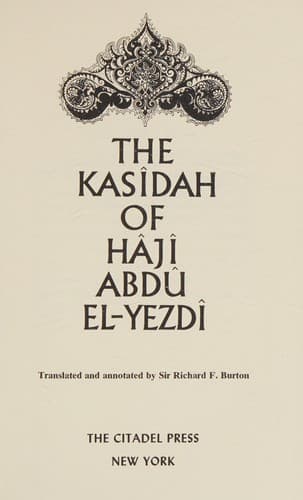
The Kasîdah of Hâjî Abdû El-YezdîBurton, Richard Francis, Sir
Philosophy
The Kasîdah of Hâjî Abdû El-Yezdî
Burton, Richard Francis, Sir
English poetry -- 19th century
The Pilgrim holds with St. Augustine Absolute Evil is impossible
because it is always rising up into good. He considers the theory
of a beneficent or maleficent deity a purely sentimental fancy,
contradicted by human reason and the aspect of the world. Evil is
often the active form of good; as F. W. Newman says, so likewise
is Evil the revelation of Good. With him all existences are
equal: so long as they possess the Hindu Agasa, Life-fluid or
vital force, it matters not they be,
Fungus or oak or worm or man.
War, he says, brings about countless individual miseries, but it
forwards general progress by raising the stronger upon the ruins
of the weaker races. Earthquakes and cyclones ravage small areas;
but the former builds up earth for mans habitation, and the
latter renders the atmosphere fit for him to breathe. Hence he
echoes:
The universal Cause
Acts not by partial but by general laws.
Ancillary to the churchmans immoral view of original sin is
the unscientific theory that evil came into the world with Adam
and his seed. Let us ask what was the state of our globe in the
pre-Adamite days, when the tyrants of the Earth, the huge
Saurians and other monsters, lived in perpetual strife, in a
destructiveness of which we have now only the feeblest examples?
What is the actual state of the world of waters, where the only
object of life is death, where the Law of murder is the Law of
Development?
Some will charge the Hâjî with irreverence, and hold him a
lieutenant of Satan who sits in the chair of pestilence. But he
is not intentionally irreverent. Like men of far higher strain,
who deny divinely the divine, he speaks the things that others
think and hide. With the author of Supernatural Religion, he
holds that we gain infinitely more than we lose in abandoning
belief in the reality of revelation; and he looks forward to the
day when the old tyranny shall have been broken, and when the
anarchy of transition shall have passed away. But he is an
Eastern. When he repeats the Greeks Remember not to believe,
he means Strive to learn, to know, for right ideas lead to right
actions. Among the couplets not translated for this eclogue is:
Of all the safest ways of Life
the safest way is still to doubt,
Men win the future world with Faith,
the present world they win without.
This is the Spaniards:
De las cosas mas seguras, mas seguro es duvidar;
a typically modern sentiment of the Brazen Age of Science
following the Golden Age of Sentiment. But the Pilgrim
continues:
The sages say: I tell thee no!
with equal faith all Faiths receive;
None more, none less, for Doubt is Death:
they live the most who most believe.
Public-domain text, read in full here on John Shaqi.
Reviews
Reviews
No reviews yet
Be the first to share your thoughts on this work.
Join the Discussion
Join the discussion
Sign in to leave a comment or review.
Sign InorCreate an account