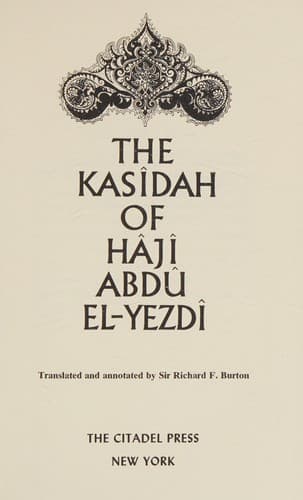
The Kasîdah of Hâjî Abdû El-YezdîBurton, Richard Francis, Sir
Philosophy
The Kasîdah of Hâjî Abdû El-Yezdî
Burton, Richard Francis, Sir
English poetry -- 19th century
With Cardinal Newman, one of the glories of our age, Hâjî Abdû
finds the Light of the world nothing else than the Prophets
scroll, full of lamentations and mourning and woe. I cannot
refrain from quoting all this fine passage, if it be only for the
sake of its lame and shallow deduction. To consider the world in
its length and breadth, its various history and the many races of
men, their starts, their fortunes, their mutual alienation, their
conflicts, and then their ways, habits, governments, forms of
worship; their enterprises, their aimless courses, their random
achievements and acquirements, the impotent conclusion of
long-standing facts, the tokens so faint and broken of a
superintending design, the blind evolution (!) of what turn out
to be great powers or truths, the progress of things as if from
unreasoning elements, not towards final causes; the greatness and
littleness of man, his far-reaching aims and short duration. the
curtain hung over his futurity, the disappointments of life, the
defeat of good, the success of evil, physical pain, mental
anguish, the prevalence and intensity of sin, the pervading
idolatries, the corruptions, the dreary hopeless irreligion, that
condition of the whole race so fearfully yet exactly described in
the Apostles words, having no hope and without God in the
world_all this is a vision to dizzy and appall, and inflicts
upon the mind the sense of a profound mystery which is absolutely
without human solution_. Hence that admirable writer postulates
some terrible original calamity; and thus the hateful doctrine,
theologically called original sin, becomes to him almost as
certain as that the world exists, and as the existence of God.
Similarly the Schedule of Doctrines of the most liberal
Christian Church insists upon the human depravity, and the
absolute need of the Holy Spirits agency in mans regeneration
and sanctification.
But what have we here? The original calamity was either caused
by God or arose without leave of God, in either case degrading
God to man. It is the old dilemma whose horns are the
irreconcilable attributes of goodness and omniscience in the
supposed Creator of sin and suffering. If the one quality be
predicable, the other cannot be predicable of the same subject.
Far better and wiser is the essayists poetical explanation now
apparently despised because it was the fashionable doctrine of
the sage bards day:
All nature is but art . . .
All discord harmony not understood;
All partial evil universal good.(Essay 289292.)
Public-domain text, read in full here on John Shaqi.
Reviews
Reviews
No reviews yet
Be the first to share your thoughts on this work.
Join the Discussion
Join the discussion
Sign in to leave a comment or review.
Sign InorCreate an account