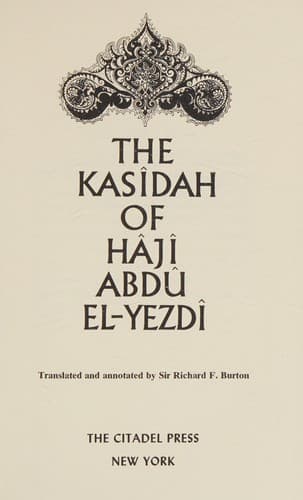
The Kasîdah of Hâjî Abdû El-YezdîBurton, Richard Francis, Sir
Philosophy
The Kasîdah of Hâjî Abdû El-Yezdî
Burton, Richard Francis, Sir
English poetry -- 19th century
This again is his modified fatalism. He would not accept the
boisterous mode of cutting the Gordian-knot proposed by the noble
British Philisterwe know were free and theres an end on it!
He prefers Lamarcks, The will is, in truth, never free. He
believes man to be a co-ordinate term of Natures great
progression; a result of the interaction of organism and
environment, working through cosmic sections of time. He views
the human machine, the pipe of flesh, as depending upon the
physical theory of life. Every corporeal fact and phenomenon
which, like the tree, grows from within or without, is a mere
product of organization; living bodies being subject to the
natural law governing the lifeless and the inorganic. Whilst the
religionist assures us that man is not a mere toy of fate, but a
free agent responsible to himself, with work to do and duties to
perform, the Hâjî, with many modern schools, holds Mind to be a
word describing a special operation of matter; the faculties
generally to be manifestations of movements in the central
nervous system; and every idea, even of the Deity, to be a
certain little pulsation of a certain little mass of animal
pap,the brain. Thus he would not object to relationship with a
tailless catarrhine anthropoid ape, descended from a monad or a
primal ascidian.
Hence he virtually says, I came into the world without having
applied for or having obtained permission; nay, more, without my
leave being asked or given. Here I find myself hand-tied by
conditions, and fettered by laws and circumstances, in making
which my voice had no part. While in the womb I was an automaton;
and death will find me a mere machine. Therefore not I, but the
Law, or if, you please, the Lawgiver, is answerable for all my
actions. Let me here observe that to the Western mind Law
postulates a Lawgiver; not so to the Eastern, and especially to
the Soofi, who holds these ideas to be human, unjustifiably
extended to interpreting the non-human, which men call the
Divine.
Further he would say, I am an individual (_qui nil habet
dividui_), a circle touching and intersecting my neighbours at
certain points, but nowhere corresponding, nowhere blending.
Physically I am not identical in all points with other men.
Morally I differ from them: in nothing do the approaches of
knowledge, my five organs of sense (with their Shelleyan
interpretation), exactly resemble those of any other being.
_Ergo_, the effect of the world, of life, of natural objects,
will not in my case be the same as with the beings most
resembling me. Thus I claim the right of creating or modifying
for my own and private use the system which most imports me; and
if the reasonable leave be refused to me, I take it without
leave.
Public-domain text, read in full here on John Shaqi.
Reviews
Reviews
No reviews yet
Be the first to share your thoughts on this work.
Join the Discussion
Join the discussion
Sign in to leave a comment or review.
Sign InorCreate an account