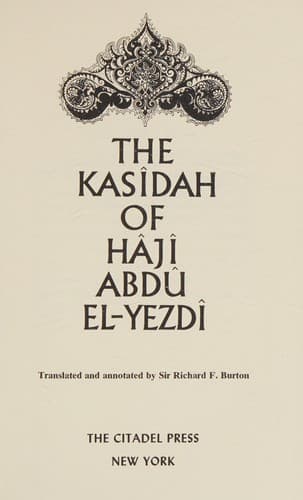
The Kasîdah of Hâjî Abdû El-YezdîBurton, Richard Francis, Sir
Philosophy
The Kasîdah of Hâjî Abdû El-Yezdî
Burton, Richard Francis, Sir
English poetry -- 19th century
But my individuality, however all-sufficient for myself, is an
infinitesimal point, an atom subject in all things to the Law of
Storms called Life. I feel, I know that Fate _is_. But I cannot
know what is or what is not fated to befall me. Therefore in the
pursuit of perfection as an individual lies my highest, and
indeed my only duty, the I being duly blended with the We. I
object to be a selfless man, which to me denotes an inverted
moral sense. I am bound to take careful thought concerning the
consequences of every word and deed. When, however, the Future
has become the Past, it would be the merest vanity for me to
grieve or to repent over that which was decreed by universal
Law.
The usual objection is that of mans practice. It says, This is
well in theory; but how carry it out? For instance, why would you
kill, or give over to be killed, the man compelled by Fate to
kill your father? Hâjî Abdû replies, I do as others do, not
because the murder was done by him, but because the murderer
should not be allowed another chance of murdering. He is a tiger
who has tasted blood and who should be shot. I am convinced that
he was a tool in the hands of Fate, but that will not prevent my
taking measures, whether predestined or not, in order to prevent
his being similarly used again.
As with repentance so with conscience. Conscience may be a fear
which is the shadow of justice; even as pity is the shadow of
love. Though simply a geographical and chronological accident,
which changes with every age of the world, it may deter men from
seeking and securing the prize of successful villainy. But this
incentive to beneficence must be applied to actions that will be
done, not to deeds that have been done.
The Hâjî, moreover, carefully distinguishes between the working
of fate under a personal God, and under the Reign of Law. In the
former case the contradiction between the foreknowledge of a
Creator, and the free-will of a Creature, is direct, palpable,
absolute. We might as well talk of black-whiteness and of
white-blackness. A hundred generations of divines have never been
able to ree the riddle; a million will fail. The difficulty is
insurmountable to the Theist whose Almighty is perforce
Omniscient, and as Omniscient, Prescient. But it disappears when
we convert the Person into Law, or a settled order of events;
subject, moreover, to certain exceptions fixed and immutable, but
at present unknown to man. The difference is essential as that
between the penal code with its narrow forbiddal, and the broad
commandment which is a guide rather than a task-master.
Public-domain text, read in full here on John Shaqi.
Reviews
Reviews
No reviews yet
Be the first to share your thoughts on this work.
Join the Discussion
Join the discussion
Sign in to leave a comment or review.
Sign InorCreate an account