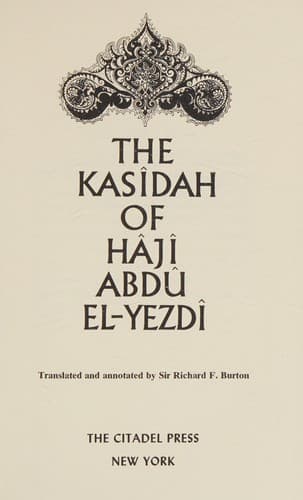
The Kasîdah of Hâjî Abdû El-YezdîBurton, Richard Francis, Sir
Philosophy
The Kasîdah of Hâjî Abdû El-Yezdî
Burton, Richard Francis, Sir
English poetry -- 19th century
But the Pilgrim is dissatisfied with the idea that evil
originates in the individual actions of free agents, ourselves
and others. This doctrine fails to account for its
characteristics,essentiality and universality. That creatures
endowed with the mere possibility of liberty should not always
choose the Good appears natural. But that of the milliards of
human beings who have inhabited the Earth, not one should have
been found invariably to choose Good, proves how insufficient is
the solution. Hence no one believes in the existence of the
complete man under the present state of things. The Hâjî rejects
all popular and mythical explanation by the Fall of Adam, the
innate depravity of human nature, and the absolute perfection of
certain Incarnations, which argues their divinity. He can only
wail over the prevalence of evil, assume its foundation to be
error, and purpose to abate it by unrooting that Ignorance which
bears and feeds it.
His eschatology, like that of the Soofis generally, is vague
and shadowy. He may lean towards the doctrine of Marc Aurelius,
The unripe grape, the ripe and the dried: all things are changes
not into nothing, but into that which is not at present. This is
one of the _monstruosa opinionum portenta_ mentioned by the XIXth
General Council, alias the First Council of the Vatican. But he
only accepts it with a limitation. He cleaves to the ethical, not
to the intellectual, worship of Nature, which moderns define to
be an unscientific and imaginary synonym for the sum total of
observed phenomena. Consequently he holds to the dark and
degrading doctrines of the Materialist, the Hylotheist; in
opposition to the spiritualist, a distinction far more marked in
the West than in the East. Europe draws a hard, dry line between
Spirit and Matter: Asia does not.
Among us the Idealist objects to the Materialists that the latter
cannot agree upon fundamental points; that they cannot define
what is an atom; that they cannot account for the transformation
of physical action and molecular motion into consciousness; and
_vice versâ_, that they cannot say what matter is; and, lastly,
that Berkeley and his school have proved the existence of spirit
while denying that of matter.
Public-domain text, read in full here on John Shaqi.
Reviews
Reviews
No reviews yet
Be the first to share your thoughts on this work.
Join the Discussion
Join the discussion
Sign in to leave a comment or review.
Sign InorCreate an account