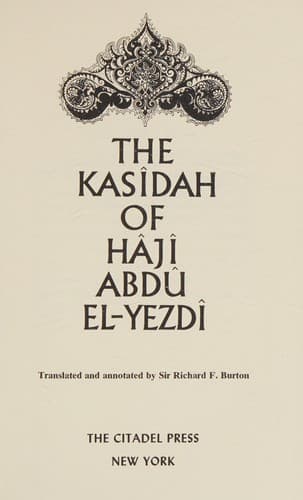
The Kasîdah of Hâjî Abdû El-YezdîBurton, Richard Francis, Sir
Philosophy
The Kasîdah of Hâjî Abdû El-Yezdî
Burton, Richard Francis, Sir
English poetry -- 19th century
The Materialists reply that the want of agreement shows only a
study insufficiently advanced; that man cannot describe an atom,
because he is still an infant in science, yet there is no reason
why his mature manhood should not pass through error and
incapacity to truth and knowledge; that consciousness becomes a
property of matter when certain conditions are present; that Hyle
({Greek: hylae}) or Matter may be provisionally defined as
phenomena with a substructure of their own, transcendental and
eternal, subject to the action, direct or indirect, of the five
senses, whilst its properties present themselves in three states,
the solid, the liquid, and the gaseous. To casuistical Berkeley
they prefer the common sense of mankind. They ask the idealist
and the spiritualist why they cannot find names for themselves
without borrowing from a dark and degraded school; why the
former must call himself after his eye (_idein_); the latter
after his breath (_spiritus_)? Thus the Hâjî twits them with
affixing their own limitations to their own Almighty Power, and,
as Socrates said, with bringing down Heaven to the market-place.
Modern thought tends more and more to reject crude idealism and
to support the monistic theory, the double aspect, the
transfigured realism. It discusses the Nature of Things in
Themselves. To the question, is there anything outside of us
which corresponds with our sensations? that is to say, is the
whole world simply I, they reply that obviously there is a
something else; and that this something else produces the
brain-disturbance which is called sensation. Instinct orders us
to do something; Reason (the balance of faculties) directs; and
the strongest motive controls. Modern Science, by the discovery
of Radiant Matter, a fourth condition, seems to conciliate the
two schools. La découverte dun quatrième état de la matière,
says a Reviewer, cest la porte ouverte à linfini de ses
transformations; cest lhomme invisible et impalpable de même
possible sans cesser dêtre substantiel; cest le monde des
esprits entrant sans absurdité dans la domaine des hypothèses
scientifiques; cest la possibilité pour le matérialiste de
croire à la vie doutre tombe, sans renoncer au substratum
matériel quil croit nécessaire au maintien de lindividualité.
Public-domain text, read in full here on John Shaqi.
Reviews
Reviews
No reviews yet
Be the first to share your thoughts on this work.
Join the Discussion
Join the discussion
Sign in to leave a comment or review.
Sign InorCreate an account