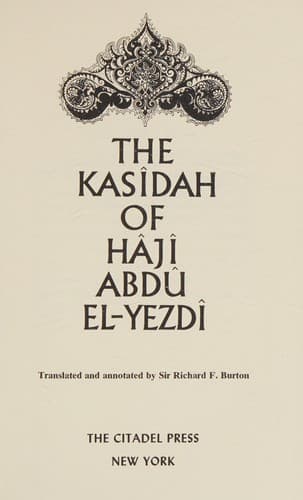
The Kasîdah of Hâjî Abdû El-YezdîBurton, Richard Francis, Sir
Philosophy
The Kasîdah of Hâjî Abdû El-Yezdî
Burton, Richard Francis, Sir
English poetry -- 19th century
Lives
Lived in obedience to the inner law
Which cannot alter.
[1] The Eternal Gardener: so the old inscription saying:
locatus est in
Homo damnatus est in horto
humatus est in
renatus est in
NOTE II
A few words concerning the Kasîdah itself. Our Hâjî begins with a
_mise-en-scène_; and takes leave of the Caravan setting out for
Mecca. He sees the Wolfs tail (_Dum-i-gurg_), the {Greek:
lykaugés}, or wolf-gleam, the Diluculum, the Zodiacal dawn-light,
the first faint brushes of white radiating from below the Eastern
horizon. It is accompanied by the morning-breath (_Dam-i-Subh_),
the current of air, almost imperceptible except by the increase
of cold, which Moslem physiologists suppose to be the early
prayer offered by Nature to the First Cause. The Ghoul-i-Biyâbân
(Desert-Demon) is evidently the personification of mans fears
and of the dangers that surround travelling in the wilds. The
wold-where-none-save-He (Allah)-can-dwell is a great and
terrible wilderness (_Dasht-i-lâ-siwâ Hu_); and Allahs Holy Hill
is Arafât, near Mecca, which the Caravan reaches after passing
through Medina. The first section ends with a sore lament that
the meetings of this world take place upon the highway of
Separation; and the original also has:
The chill of sorrow numbs my thought:
methinks I hear the passing knell;
As dies across yon thin blue line
the tinkling of the Camel-bell.
The next section quotes the various aspects under which Life
appeared to the wise and foolish teachers of humanity. First
comes Hafiz, whose well-known lines are quoted beginning with
Shab-i-târîk o bîm-i-mauj, etc. Hûr is the plural of Ahwar, in
full Ahwar el-Ayn, a maid whose eyes are intensely white where
they should be white, and black elsewhere: hence our silly
Houries. Follows Umar-i-Khayyâm, who spiritualized Tasawwof, or
Sooffeism, even as the Soofis (Gnostics) spiritualized Moslem
Puritanism. The verses alluded to are:
You know, my friends, with what a brave carouse
I made a second marriage in my house,
Divorced old barren Reason from my bed
And took the Daughter of the Vine to spouse.
(St. 60, Mr. Fitzgeralds translation.)
Public-domain text, read in full here on John Shaqi.
Reviews
Reviews
No reviews yet
Be the first to share your thoughts on this work.
Join the Discussion
Join the discussion
Sign in to leave a comment or review.
Sign InorCreate an account