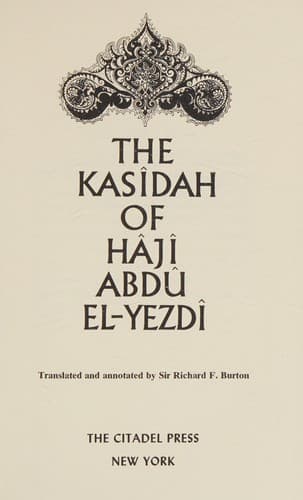
The Kasîdah of Hâjî Abdû El-YezdîBurton, Richard Francis, Sir
Philosophy
The Kasîdah of Hâjî Abdû El-Yezdî
Burton, Richard Francis, Sir
English poetry -- 19th century
With Hâjî Abdû the soul is not material, for that would be a
contradiction of terms. He regards it, with many moderns, as a
state of things, not a thing; a convenient word denoting the
sense of personality, of individual identity. In its ghostly
signification he discovers an artificial dogma which could hardly
belong to the brutal savages of the Stone Age. He finds it in the
funereal books of ancient Egypt, whence probably it passed to the
Zendavesta and the Vedas. In the Hebrew Pentateuch, of which part
is still attributed to Moses, it is unknown, or, rather, it is
deliberately ignored by the author or authors. The early
Christians could not agree upon the subject; Origen advocated the
pre-existence of mens souls, supposing them to have been all
created at one time and successively embodied. Others make Spirit
born with the hour of birth: and so forth.
But the brain-action or, if you so phrase it, the mind, is not
confined to the reasoning faculties; nor can we afford to ignore
the sentiments, the affections which are, perhaps, the most
potent realities of life. Their loud affirmative voice contrasts
strongly with the titubant accents of the intellect. They seem to
demand a future life, even, a state of rewards and punishments
from the Maker of the world, the _Ortolano Eterno_,[1] the Potter
of the East, the Watchmaker of the West. They protest against the
idea of annihilation. They revolt at the notion of eternal
parting from parents, kinsmen and friends. Yet the dogma of a
future life is by no means catholic and universal. The
Anglo-European race apparently cannot exist without it, and we
have lately heard of the Aryan Soul-land. On the other hand
many of the Buddhist and even the Brahman Schools preach Nirwâna
(comparative non-existence) and Parinirwâna (absolute
nothingness). Moreover, the great Turanian family, actually
occupying all Eastern Asia, has ever ignored it; and the
200,000,000 of Chinese Confucians, the mass of the nation,
protest emphatically against the mainstay of the western creeds,
because it unfits men for the business and duty of life by
fixing their speculations on an unknown world. And even its
votaries, in all ages, races and faiths, cannot deny that the
next world is a copy, more or less idealized, of the present; and
that it lacks a single particular savouring of originality. It is
in fact a mere continuation; and the continuation is not
proven.
It is most hard to be a man;
and the Pilgrims sole consolation is in self-cultivation, and in
the pleasures of the affections. This sympathy may be an indirect
self-love, a reflection of the light of egotism: still it is so
transferred as to imply a different system of convictions. It
requires a different name: to call benevolence self-love is to
make the fruit or flower not only depend upon a root for
development (which is true), but the very root itself (which is
false). And, finally, his ideal is of the highest: his praise is
reserved for:
Public-domain text, read in full here on John Shaqi.
Reviews
Reviews
No reviews yet
Be the first to share your thoughts on this work.
Join the Discussion
Join the discussion
Sign in to leave a comment or review.
Sign InorCreate an account