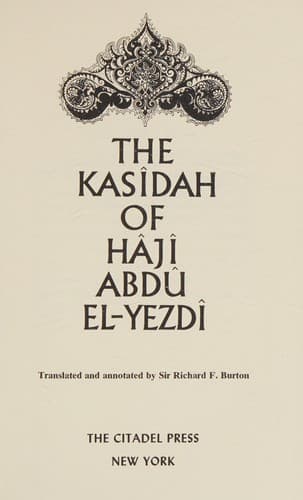
The Kasîdah of Hâjî Abdû El-YezdîBurton, Richard Francis, Sir
Philosophy
The Kasîdah of Hâjî Abdû El-Yezdî
Burton, Richard Francis, Sir
English poetry -- 19th century
The next section is one long wail over the contradictions, the
mysteries, the dark end, the infinite sorrowfulness of all
existence, and the arcanum of grief which, Luther said, underlies
all life. As with Euripides to live is to die, to die is to
live. Hâjî Abdû borrows the Hindu idea of the human body. It is
a mansion, says Menu, with bones for its beams and rafters;
with nerves and tendons for cords; with muscles and blood for
cement; with skin for its outer covering; filled with no sweet
perfume, but loaded with impurities; a mansion infested by age
and sorrow; the seat of malady; harassed with pains; haunted with
the quality of darkness (Tama-guna), and incapable of standing.
The Pot and Potter began with the ancient Egyptians. Sitting as
a potter at the wheel, Cneph (at Philæ) moulds clay, and gives
the spirit of life to the nostrils of Osiris. Hence the
Genesitic breath. Then we meet him in the Vedas, the Being by
whom the fictile vase is formed; the clay out of which it is
fabricated. We find him next in Jeremiahs Arise and go down
unto the Potters house, etc. (xviii. 2), and lastly in Romans
(ix. 20), Hath not the potter power over the clay? No wonder
that the first Hand who moulded the man-mud is a _lieu commun_ in
Eastern thought. The waste of agony is Buddhism, or
Schopenhauerism pure and simple, I have moulded Earth on Earth
upon Seint Ysidres well-known rhymes (A.D. 1440):
Erthe out of Erthe is wondirli wrouzt,
Erthe out of Erthe hath gete a dignity of nouzt,
Erthe upon Erthe hath sett all his thouzt
How that Erthe upon Erthe may be his brouzt, etc.
The Camel-rider, suggests Ossian, yet a few years and the
blast of the desert comes. The dromedary was chosen as Deaths
vehicle by the Arabs, probably because it bears the Bedouins
corpse to the distant burial-ground, where he will lie among his
kith and kin. The end of this section reminds us of:
How poor, how rich; how abject, how august,
How complicate, how wonderful is Man!
The Hâjî now passes to the results of his long and anxious
thoughts: I have purposely twisted his exordium into an echo of
Milton:
Till old experience doth attain
To something of prophetic strain.
Public-domain text, read in full here on John Shaqi.
Reviews
Reviews
No reviews yet
Be the first to share your thoughts on this work.
Join the Discussion
Join the discussion
Sign in to leave a comment or review.
Sign InorCreate an account