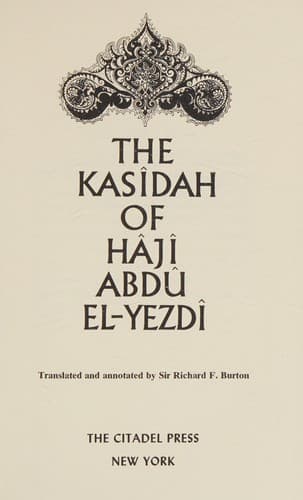
The Kasîdah of Hâjî Abdû El-YezdîBurton, Richard Francis, Sir
Philosophy
The Kasîdah of Hâjî Abdû El-Yezdî
Burton, Richard Francis, Sir
English poetry -- 19th century
He boldly declares that there is no God as man has created his
Creator. Here he is at one with modern thought:En général les
croyants font le Dieu comme ils sont eux-mêmes, (says J. J.
Rousseau, Confessions, I. 6): les bons le font bon: les
méchants le font méchant: les dévots haineux et bilieux, ne
voient que lenfer, parce quils voudraient damner tout le monde;
les âmes aimantes et douces ny croient guère; et lun des
étonnements dont je ne reviens pas est de voir le bon Fénélon en
parler dans son Télémaque comme sil y croyoit tout de bon: mais
jespère quil mentoit alors; car enfin quelque véridique quon
soit, il faut bien mentir quelquefois quand on est évêque. Man
depicts himself in his gods, says Schiller. Hence the
_Naturgott_, the deity of all ancient peoples, and with which
every system began, allowed and approved of actions distinctly
immoral, often diabolical. Belief became moralized only when the
conscience of the community, and with it of the individual items,
began aspiring to its golden age,Perfection. Dieu est le
superlatif, dont le positif est lhomme, says Carl Vogt;
meaning, that the popular idea of a _numen_ is that of a
magnified and non-natural man.
He then quotes his authorities. Buddha, whom the Catholic Church
converted to Saint Josaphat, refused to recognize Ishwara (the
deity), on account of the mystery of the cruelty of things.
Schopenhauer, Miss Cobbes model pessimist, who at the humblest
distance represents Buddha in the world of Western thought, found
the vision of mans unhappiness, irrespective of his actions, so
overpowering that he concluded the Supreme Will to be malevolent,
heartless, cowardly, and arrogant. Confucius, the Throneless
king, more powerful than all kings, denied a personal deity. The
Epicurean idea rules the China of the present day. God is great,
but he lives too far off, say the Turanian Santâls in Aryan
India; and this is the general language of man in the Turanian
East.
Public-domain text, read in full here on John Shaqi.
Reviews
Reviews
No reviews yet
Be the first to share your thoughts on this work.
Join the Discussion
Join the discussion
Sign in to leave a comment or review.
Sign InorCreate an account