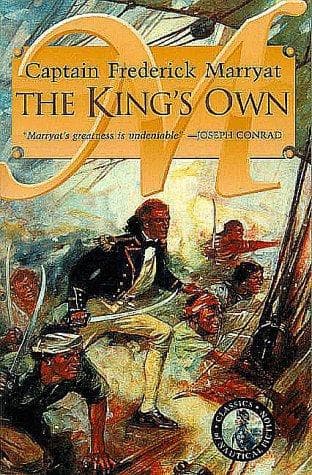
Great Britain -- History, Naval -- 18th century -- Fiction; Nore Mutiny, 1797 -- Fiction
The example shown by Adams was not followed--the ship's crew again
cheered, and ran down the hatchways, leaving the officers and marines on
deck. They first disarmed the sentry under the half-deck, and released
the prisoners, and then went forward to consult upon further operations.
They were not long in deciding. A boatswain's mate, who was one of the
ringleaders, piped, "Stand by hammocks!" The men ran on deck, each
seizing a hammock, and jumping with it down below on the main deck. The
object of this manoeuvre not being comprehended, they were suffered to
execute it without interruption. In a few minutes they sent up the
marine, whom they had disarmed when sentry over the prisoners, to state
that they wished to speak to the captain and officers, who, after some
discussion, agreed that they would descend and hear the proposals which
the ship's company should make. Indeed, even with the aid of the
marines, many of whom were wavering, resistance would now have been
useless, and could only have cost them their lives; for they were
surrounded by other ships who had hoisted the flag of insubordination,
and whose guns were trained ready to pour in a destructive fire on the
least sign of an attempt to purchase their anchor. To the main deck
they consequently repaired.
The scene which here presented itself was as striking as it was novel.
The after-part of the main-deck was occupied by the captain and
officers, who had come down with the few marines who still continued
steadfast to their duty, and one sailor only, Adams, who had so nobly
stated his determination on the quarter-deck. The foremost part of the
deck was tenanted by a noisy and tumultuous throng of seamen, whose
heads only appeared above a barricade of hammocks, which they had formed
across the deck, and out of which at two embrasures, admirably
constructed, two long twenty-four pounders, loaded up to the muzzle with
grape and canister shot, were pointed aft in the direction where the
officers and marines were standing--a man at the breech of each gun,
with a match in his hand (which he occasionally blew, that the priming
powder might be more rapidly ignited), stood ready for the signal to
fire.
The captain, aghast at the sight, would have retreated, but the
officers, formed of sterner materials, persuaded him to stay, although
he showed such evident signs of fear and perturbation as seriously to
injure a cause in which resolution and presence of mind alone could
avail. The mutineers, at the suggestion of Peters, had already sent aft
their preliminary proposals, which were, that the officers and marines
should surrender up their arms, and consider themselves under an arrest,
intimating at the same time that the first step in advance made by any
one of their party would be the signal for applying the match to the
touch-holes of the guns.
Public-domain text, read in full here on John Shaqi.
Reviews
Reviews
No reviews yet
Be the first to share your thoughts on this work.
Join the Discussion
Join the discussion
Sign in to leave a comment or review.
Sign InorCreate an account